


Verdant Mountains
Overall: 13 1/4 × 343 3/4 inches (33.66 × 873.13 cm)
Image (Frontispiece with calligraphy (yinshou)): 13 1/4 × 23 3/4 inches (33.66 × 60.33 cm)
Mount (Sectional mount (geshui)): 13 1/4 × 4 3/4 inches (33.66 × 12.07 cm)
- 222
Allen Memorial Art Museum, Oberlin (OH) College. March-April 1954.
Chinese Landscape Painting, Cleveland Museum of Art, November 4-December 26, 1954.
Chinese Painting, Royal Ontario Museum, Toronto, May 7-June 10, 1956; National Gallery of Art, Ottawa, June 15-July 3, 1956.
Oriental Ceramic Society, Sung exhibition, Arts Council of Great Britain, June 15-July 23, 1960.
Chinese Art, Smith College Museum of Art, Northampton, Massachusetts, January 8-26, 1962.
Oriental art exhibition, Washington University, St. Louis, January 23-March 4, 1966.
Man and His World, National Gallery of Canada, Ottawa (organizer). Expo '67 (at the Fine Arts Gallery in Montreal) April 28-October 27, 1967.
Eight Dynasties of Chinese Painting, Nelson-Gallery-Atkins Museum, Kansas City, November 7, 1980 – January 4, 1981; The Cleveland Museum of Art, February 7 – April 5, 1981; The Asia Society, December 3, 1981 – February 28, 1982; Tokyo National Museum, October 4 – November 17, 1982, no. 23.
Masterpieces of Early Chinese Painting and Calligraphy in American Collections, Shanghai Museum, October 16, 2012- January 17, 2013, no. 2.2.
Journey through Mountains and Rivers: Chinese Landscapes Ancient and Modern, The Nelson-Atkins Museum of Art, Kansas City, MO, February 8- April 28, 2013.
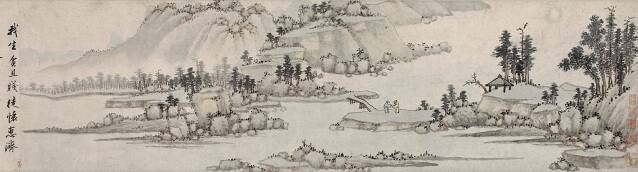
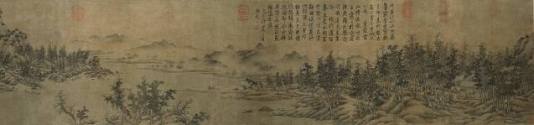
On the right, a thatched hut quietly awaits its host and guest, who casually stroll toward the hut in the verdant bushes. The blue river, trail, and bridges connect the rolling hills in this lengthy handscroll. To the far left of the painting, a temple with a multi-storied pagoda stands at the hilltop, concluding a contemplative journey.
Jiang Shen may have been inspired by the rivers and lakes that dominated the Southern Song capital, Hangzhou, where he lived. He used moist, soft brushwork to portray the luxuriant landscape and people enjoying the fresh nature.
Liang Qingbiao 梁清標 (1620-1691), by 1691 [1];
Qing Dynasty imperial court, Peking (modern-day Beijing), China [2];
Given to Pujie 溥傑 (1907-1994), Peking, 1922 [3];
Possibly Zhang Wenkui 張文魁 (1905-1967), Shanghai and Hong Kong [4];
With C. T. Loo & Co., New York, NY, stock no. 7206, July 1949-1953 [5];
Purchased from C. T. Loo & Co. by The Nelson-Atkins Museum of Art, Kansas City, MO, 1953.
NOTES:
[1] A seal on the painting is identified with Liang Qingbiao's ownership.
[2] This handscroll is listed in Guoli Beiping Gugong bowuyuan 國立北平故宮博物院, ed., Four Catalogues of the Lost Paintings and Calligraphy from the Old Palace (Gugong yiyi shuhua mulu sizhong 故宮已佚書畫目錄四種) (Beijing, compiled 1925; published 1934).
[3] Ibid. Pujie was the younger brother of Pu Yi, the last emperor Xuantong (1906-1967). The catalogue records that the handscroll was given to him on the 20th day of the eleventh month, in the fourteenth year of Xuantong era (1922).
[4] Zhang Wenkui is listed as a previous owner of this scroll in Yang Renkai, Guobao shenfu lu: Gugong sanyi shuhua jianwen kaolue (Shanghai: Renmin meishu chubanshe, 1991), 233-34. No seal or physical evidence pertaining to his ownership has been located on the painting.
[5] C. T. Loo and Frank Caro archive, Musée Guimet, Paris, copy of stock card in NAMA curatorial files. Loo placed the painting on loan to the Nelson-Atkins beginning in June 1951.
Shi qu bao ji xu bian [Catalogue of painting and calligraphy in the imperial collection: sequel (part II)]. Compiled by Wang Chieh et al.; commissioned by the Qianlong emperor 1791, completed 1793. Facsimile reprint. (Shanghai, Yushufang 1948) ch. 36, 13a-b.
Gu Gung Zhou Kan, 834, no. 15.
Archives of the Chinese Art Society of America, VII (New York: 1953), 86, fig. 18, pl. 5, ff.
Reinhardt, “Cycles Through the Chinese Landscape,” Art News, vol. 53 (December 1954), 25.
Sherman E. Lee, Chinese Landscape Painting, exh. cat. (Cleveland Museum of Art, 1954), 30-31, no. 16., 2nd ed. rev. 1962, 26-27, no. 18.
Laurence Sickman and Alexander Soper, The Art and Architecture of China, Pelican History of Art, Ed. N. Pevsner (Harmondsworth, 1956, 1968), pl. 104; paperback ed. 1971, 248, pl. 171).
Osvald Sirén, Chinese Painting: Leading Masters and Principles, (New York: 1956-1958), vol. II, 99; vol. III, pl. 257-258.
Tseng Hsien- ch’i, Loan Exhibition of Chinese Paintings, exh. cat.: Royal Ontario Museum of Archaeology (Toronto: 1956), pl. 5.
Arts of the Sung Dynasty, exh. cat. Arts Council of Great Britain (London: 1960), no. 4, pl. 1.
John Ayers, “Arts of the Sung Dynasty,” Country Life (June 30, 1960), 1486, fig. 1.
Ross E. Taggart, ed., Handbook of the Collections in the William Rockhill Nelson Gallery of Art and Mary Atkins Museum of Fine Arts, 4th ed. (Kansas City, MO: William Rockhill Nelson Gallery of Art and Mary Atkins Museum of Fine Arts, 1959), 200.
Chinese Art, exh. cat. Smith College Museum of Art (Northampton: 1962), pls. II, III, no. 2.
William Willetts, Foundations of Chinese Art from Neolithic Pottery to Modern Architecture (New York: 1965), pl. 214.
Man and His World, exh. cat.: International the Fine Arts Exhibition, Expo 67 (Montreal: 1967), 164.
Horizon magazine, ed. Arts of China (New York: 1969), 28-29.
Terukazu Akiyama etc al. eds. Chugoku bijutsu [Chinese art in Western collections] (Tokyo: 1972), Kaiga [paintings], ed. Kei Suzuki and Terukazu Akiyama, 1972, pl. 14.
Ross E. Taggart, George L. McKenna, and Marc F. Wilson, eds., Handbook of the Collections in The William Rockhill Nelson Gallery of Art and Mary Atkins Museum of Fine Arts, Kansas City, Missouri, vol. II, Art of the Orient. (Kansas City, MO: William Rockhill Nelson Gallery of Art and Mary Atkins Museum of Fine Arts, 1973), 52.
Marc F. Wilson, “The Chinese Painter and his Vision”, Apollo, special issue for the Asian art collection in the Nelson-Atkins Museum of Art, Vol. XCVII, no. 133 (March 1973): 230-231, fig. 5.
Richard M. Barnhart, Yoshitaka Iriya, Yujiro Nakada, To Gen, Kyonen [Tung Yuan, Chu-jan] Bunjinga suihen [Essence of Chinese and Japanese literati paintings]. vol. II (Tokyo: 1977), 91, 142, 152. pl. 75, fig. 29.
Michael Sullivan, Symbols of Eternity: The Art of Landscape Painting in China (Stanford: Stanford University Press, 1979), 83, fig. 49.
Wai-Kam Ho, et al., Eight Dynasties of Chinese Painting: The Collections of the Nelson Gallery-Atkins Museum, Kansas City, and The Cleveland Museum of Art (The Cleveland Museum of Art in cooperation with Indiana University Press, c1980), 41-42, no. 23.
Kwan S. Wong, “A Study of Chiang Shen’s Family Background & Life,” Soochow University Journal of Chinese Art History, vol. XI, (July 1981), 26-48; English summary: 45-48.
Roger Ward and Patricia J. Fidler, eds., The Nelson-Atkins Museum of Art: A Handbook of the Collection (New York: Hudson Hills Press, in association with Nelson-Atkins Museum of Art, 1993), 315.
Deborah Emont Scott, ed., The Nelson-Atkins Museum of Art: A Handbook of the Collection, 7th ed. (Kansas City, MO: Nelson-Atkins Museum of Art, 2008), 340, fig. 174.
Shanghai bo wu guan, Masterpieces of Early Chinese Painting and Calligraphy in American Collections, Shanghai Museum, (Beijing shi: Beijing da xue chu ban she, 2012), 42-43. No. 2.2.