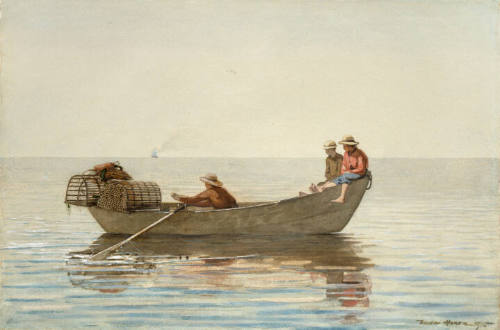
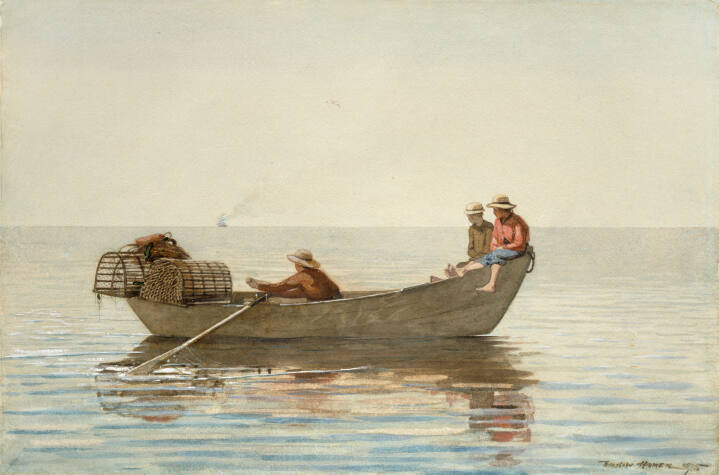
Three Boys in a Dory with Lobster Pots
Framed: 23 7/8 × 29 7/8 × 1 1/4 inches (60.64 × 75.88 × 3.18 cm)
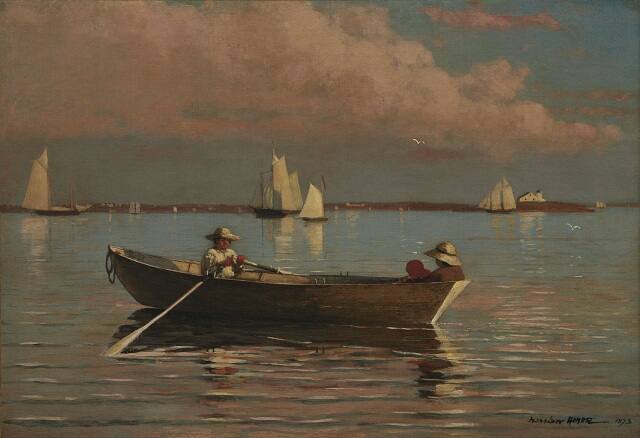
A meditation on marine life, Three Boys in a Dory with Lobster Pots revisits work Winslow Homer made during a trip to Gloucester, Massachusetts, two years earlier. On that trip Homer became fascinated by watercolor while painting the role of the ocean in the daily lives of local children. He based this watercolor on two works from the earlier trip: the oil painting Gloucester Harbor (hanging nearby) and an illustration for Harper’s Weekly. In this later watercolor, Homer stripped away the ships in the background. He focused on the boys in the dory instead of the activity of what was then one of the nation’s busiest seaports.
Probably acquired from the artist by A. Warren Kelsey (1840-1921), by 1910-1921 [1];
Probably by descent to his son, Albert Kelsey (1870-1950), Philadelphia, PA and Quogue, Long Island, 1921-1944 [2];
Purchased from Kelsey, through M. Knoedler & Co., New York, stock nos. WC846 and CA2060, by The Nelson-Atkins Museum of Art, Kansas City, MO, 1944 [3].
NOTES:
[1] Albert Warren Kelsey was a writer, scholar, and friend of Winslow Homer. Kelsey and Homer shared an apartment in Paris from 1866 to 1867. Considering their close friendship, it is likely Kelsey acquired this watercolor from the artist.
[2] Albert Kelsey was an architect who is best known for serving as the president of the Architectural League of America from 1899, founding and editing The Architectural Annual, and designing the Pan-American Union building in Washington, DC. While not yet confirmed, considering his father’s close friendship with Homer, it is likely he acquired this watercolor by descent.
[3] Getty Research Institute, Los Angeles, M. Knoedler & Co. Records, Watercolor Stock Book 5, p. 94 and Commission Book 3, p. 147, copies in Nelson-Atkins curatorial files.