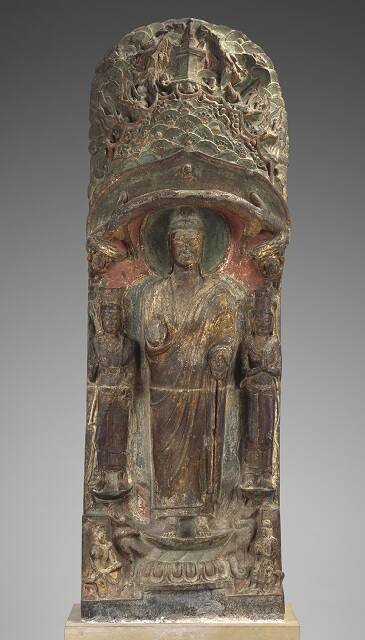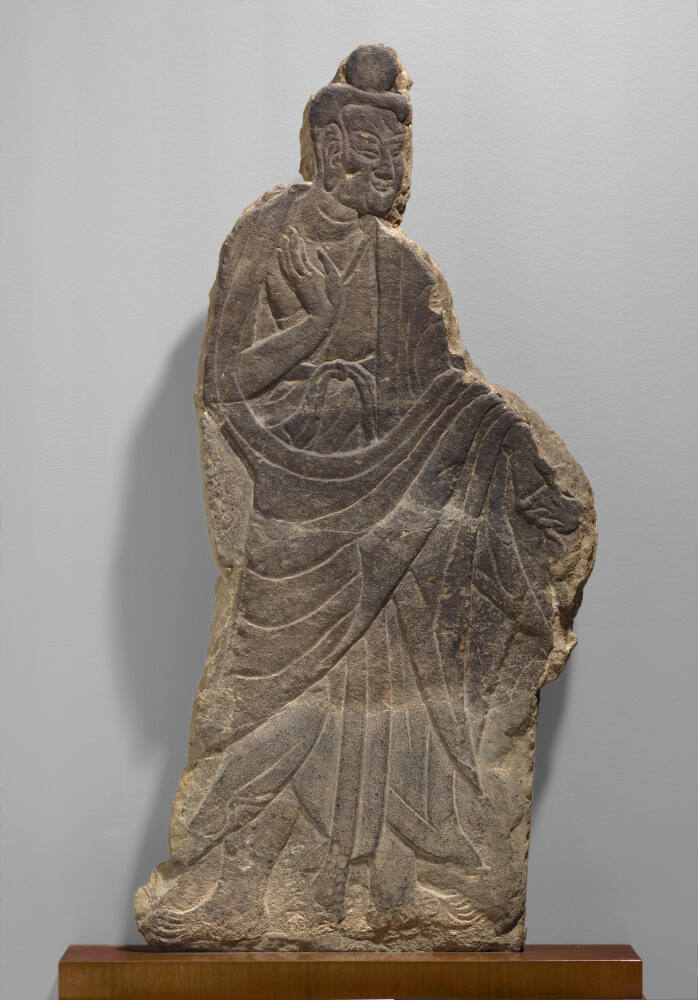

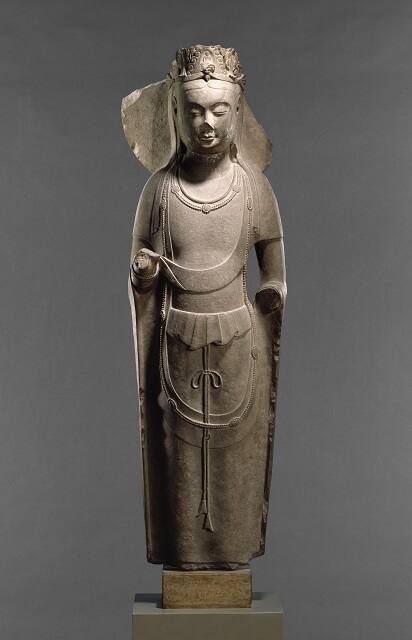
Guanyin Bodhisattva
- 204
With Otto Burchard & Co., New York and Berlin, and the Margraf Group, Berlin, probably by 1928-April 29, 1935 [1];
Purchased at the Margraf Group’s sale, Die Bestände der Firma Dr. Otto Burchard & Co, Berlin in Liquidation: chinesische Kunst (Band 2), Paul Graupe, Berlin, April 29, 1935, lot 1252, through Hans Burghard and Laurence Sickman, by The Nelson-Atkins Museum of Art, 1935 [2].
NOTES:
[1] In an oral history recorded January 21, 1983, Laurence Sickman, Nelson-Atkins Director, said the sculpture was at the Freer Gallery of Art on approval from Otto Burchard & Co., New York, during Sickman’s time there in the late 1920s. See oral history transcript, Nelson-Atkins Archives, RG70, Series III, Box 2.
Otto Burchard & Co. became part of the Margraf Group business conglomerate, which controlled numerous subsidiaries in the art trade, in 1926. Margraf was owned by Albert Loeske and managed by Jakob Oppenheimer. Upon Loeske’s death in 1929, the company was inherited by Oppenheimer and his wife, Rosa. From 1929 to 1935, the Margraf conglomerate undertook numerous liquidations and consolidations of assets in order to pay inheritance taxes to the German finance authority. In 1931, the New York branch of Otto Burchard & Co. was closed, Otto Burchard & Co. GmbH in Berlin was merged with another Margraf company, Altkunst Antiquitäten GmbH, and Otto Burchard, who lived in Peking, was replaced by Jakob Oppenheimer as the company’s manager. In March 1933, Jakob and Rosa Oppenheimer fled Nazi persecution to France, leaving the Margraf firm in the hands of their son-in-law, Ivan Bloch, a Jewish Swiss citizen. In October 1933, Bloch transferred ownership of Otto Burchard & Co. GmbH’s inventory as collateral to repay a loan Oppenheimer had taken out in 1929 from the bank Jacquier & Securius. In fulfillment of Margraf’s tax and loan liabilities, this inventory was liquidated, along with the stock of two other Margraf firms, at several Berlin auctions in 1935. For more on the history of the Margraf conglomerate in the late 1920s and early 1930s, see especially Ilse von zur Mühlen, “Finance, Taxes and Provenance: A German Museum Acquisition of Chinese Antiquities in 1935,” Journal for Art Market Studies 3 (2018), https://www.fokum-jams.org/index.php/jams/article/view/75/123.
[2] At the time of the auction, Sickman was traveling from China to the United States following the conclusion of his time as a Harvard-Yenching Fellow and purchasing agent for the Nelson-Atkins in Peking from 1931 to 1935. Although unable to attend the auction in person, he visited Berlin several days later to complete the museum’s purchase.
Hans Burghard was the business manager for Margraf from 1919 to July 1935. Sickman recorded Burghard as an agent for the transaction in the purchasing records he supplied to the Nelson-Atkins.
Paul Graupe, Berlin. Liquidation sale of Dr. Ott Burchard & Co., Berlin. 29 April 1935. Sale of Chinese art, Buddhist sculpture, lot 1252 (repro.).
Parnassus, Feb. 1936, p. 29 (repro.).
Art News, 37: 18-19, Dec. 3, 1938 (repro.).
University Prints, newton, 1938, Early Chinese art, section II, series O, pl. 171 (repro.).
Ludwig Bachhofer, Short History of Chinese Art, p. 71, fig. 64 (repro.).
The William Rockhill Nelson Gallery of Art and Mary Atkins Museum of Fine Arts, The William Rockhill Nelson Collection, 2nd ed. (Kansas City, MO: William Rockhill Nelson Gallery of Art and Mary Atkins Museum of Fine Arts, 1941), 512-153, (repro.).
The William Rockhill Nelson Gallery of Art and Mary Atkins Museum of Fine Arts, The William Rockhill Nelson Collection, 3rd ed. (Kansas City, MO: William Rockhill Nelson Gallery of Art and Mary Atkins Museum of Fine Arts, 1949), 109, (repro.).
Hugo Munsterberg, A Short History of Chinese Art (New York, Philosophical library 1949), pl. 25 (repro.).
Mario Prodan, Chinese Art (New York: 1958), pl. 37 (repro.).
Ross E. Taggart, ed., Handbook of the Collections in the William Rockhill Nelson Gallery of Art and Mary Atkins Museum of Fine Arts, 4th ed. (Kansas City, MO: William Rockhill Nelson Gallery of Art and Mary Atkins Museum of Fine Arts, 1959), 188 (repro.).
Tan Danjiong, Chinese Art (Taipei: 1960), pl. xciv (repro.).
Hugo Munsterberg, Der Ferne Osten (Baden-baden: 1968), 63 (repro.).
Chinese Art in Western Collections. Vol. 3, Sculpture (Tokyo: Kodansha, 1973), pl. 49 (repro.).
Ross E. Taggart, George L. McKenna, and Marc F. Wilson, eds., Handbook of the Collections in The William Rockhill Nelson Gallery of Art and Mary Atkins Museum of Fine Arts, Kansas City, Missouri, vol. II, Art of the Orient. (Kansas City, MO: William Rockhill Nelson Gallery of Art and Mary Atkins Museum of Fine Arts, 1973), 35 (repro.).
Laurence Sickman, “Monsters and Elegance: Nine Centuries of Chinese Sculpture” Apollo Special issue for the Asian art collection in the Nelson-Atkins Museum of Art, Vol. XCVII, no. 133, (March 1973), 36, fig. 6 (repro.).
Bradley Smith and Weng Wango, China: A History in Art (Garden City, New York: Doubleday, 1979), 122 (repro.).
Ellen R. Goheen, The Collections of the Nelson-Atkins Museum of Art (New York: Harry N. Abrams, 1988), Cat. 89 (repro.).
Roger Ward and Patricia J. Fidler, eds., The Nelson-Atkins Museum of Art: A Handbook of the Collection (New York: Hudson Hills Press, in association with Nelson-Atkins Museum of Art, 1993), 306(repro.).
Matsubara Saburō 松原三郎, Chūgoku Bukkyō chōkoku shiron 中国仏教彫刻史論 (Tōkyō : Yoshikawa Kōbunkan, Heisei 7 1995), Plate Vol. II, 541 (repro.).
Amy McNair, “The Ending of the Law and the Hope of Salvation: Some 6th Century Chinese Buddhist Sculptures in The Nelson-Atkins Museum of Art” Orientations, Vol. 39, no. 8 ( November/December 2008), 83 (repro.).
Deborah Emont Scott, ed., The Nelson-Atkins Museum of Art: A Handbook of the Collection, 7th ed. (Kansas City, MO: Nelson-Atkins Museum of Art, 2008), 319, fig. 109 (repro.).
Colin Mackenzie, with contributions by Ling-En Lu, Masterworks of Chinese art: the Nelson-Atkins Museum of Art (Kansas City, Mo.: Nelson-Atkins Museum of Art, 2011), 44-45, cat. 10 (repro.).