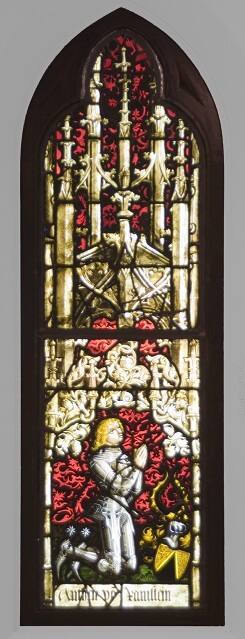
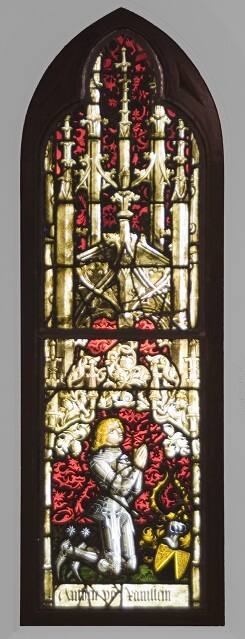
Heraldic Panel with Arms of Anton von Ramstein
- 105
Wallfahrtskirche Maria Krönung, Lautenbach, Germany, late 15th century-1878 [1];
Acquired in Germany by Edgar Speyer (1862-1932), London and New York, possibly by 1904-1932 [2];
Probably by inheritance to his wife, Leonora Speyer (1872-1956), New York, 1932-1944;
Probably consigned by Leonora Speyer to Paul Drey Gallery, New York, by September 1944 [3];
Purchased from Paul Drey by The Nelson-Atkins Museum of Art, Kansas City, MO, 1944.
NOTES:
[1] Maria Krönung was a parish and pilgrimage church dedicated to the Coronation of the Virgin Mary. This window was positioned on the north side of the church’s nave. According to Max Wingenroth, ed., “Die Kunstdenkmäler des Kreises Offenburg,” in Dr. Ing. Jos. Durm, et al, eds., Die Kunstdenkmäler des Großherzogtums Baden 7 (1908): 201-2 and other published references, this window was removed along with other glass panels from the church in the 1870s or 1880s and sent to a glass restorer named Beiler in Heidelberg. When the panels were returned to the church in 1882, Wingenroth states that some of them (potentially including the Nelson-Atkins glass) had been replaced by copies. Research is currently ongoing and may bring additional information to light about this panel’s late-19th to early-20th-century provenance.
[2] Edgar Speyer was a merchant banker who is remembered primarily for his involvement with the early construction of London’s Underground transportation system and as a patron of the arts and sciences. Speyer was born in the United States to a German Jewish family, spent his childhood in Germany, and lived in London most of his career. In 1921, he was found guilty of disloyalty and trading with the enemy under Britain’s Aliens Act and was stripped of his British citizenship. Speyer lived the rest of his life in New York. The use of historic stained glass as decorative elements in Speyer’s London home is described in P. M. Turner, “The House and Collection of Mr. Edgar Speyer,” The Burlington Magazine for Connoisseurs 5, no. 18 (September 1904): 544-555. Although no glass is seen in Turner’s photographs of the home, he may be referring to the Anton von Ramstein panel in his description of the morning room: “The room is lighted by two windows, filled with sixteenth-century glass, both in grisaille and colour” (p. 546-7). This window was certainly in the Speyer collection by 1925, when it was included as no. 211 in Walter Pach’s unpublished catalogue: “Catalogue of the Speyer Collection with Descriptive Notes by Walter Pach,” Archives of American Art, Washington, DC, Walter Pach papers, 1857-1980, Series 3.1: Writings by Pach, 1899-circa 1950s, box 3, folder 48. According to Paul Drey, in a letter to the Nelson-Atkins dated January 2, 1945, copy in curatorial files, “According to verbal remarks of the late Sir Edgar, he acquired [this panel] at or near to Baden Baden.” The Speyers often spent time in the Baden-Baden area and purchased a house there in the 1920s. They were also acquainted with the dealer J. Rosenbaum in Frankfurt, from whom the Kunstgwerbemuseum Berlin purchased another Lautenbach panel in 1913, so it is possible the Speyers purchased the Anton von Ramstein panel from Rosenbaum, but unfortunately the Rosenbaum records (held within the Rosenberg & Stiebel Archive at the Frick Art Reference Library, New York) are incomplete and contain no reference to the Speyers or the Anton von Ramstein glass. With thanks to John Hilary for sharing his valuable expertise on the Speyer collection with the Nelson-Atkins. For more on the Speyers’ collection, see his publications: “Reconstructing the Renaissance: the collection of Edgar and Leonora Speyer,” The Burlington Magazine 164, no. 1436 (November 2022), 1104-17 and “Casualties of War: The Speyer Collection,” in Magnates and Masterpieces: The German-Jewish Collectors of Edwardian Britain (New Haven, CT: Yale University Press, 2025), 110.
[3] Although no documentation has yet come to light confirming Leonora Speyer’s consignment of the glass to Paul Drey, she did sell several other items through the dealer around the same time. Additionally, Paul Drey’s brother Franz attributed a painting in the Speyer collection, known as the Speyer Madonna, to a follower of Crivelli in 1927, so the Dreys were connected to the Speyers by the mid-1920s. With thanks to John Hilary for suggesting the connection between Franz Drey and the Speyer collection.
Father Gamans, Description of the Pilgrimage Church at Lautenbach, 1644-1653, reproduced in: Hans Heid, “The oldest description of the Lautenbach pilgrimage church in Renchtal,” Freiburger Diözesan-Archiv 82/83 (1962/63), 519.
Ernst Sensburg, Beschreibung der merkwürdigen Kirche zu Lautenbach bei Oberkirch (Freiburg im Breslau, 1830), 8.
Max Wingenroth, ed., “Die Kunstdenkmäler des Kreises Offenburg,“ in Dr. Ing. Jos. Durm, et al, eds., Die Kunstdenkmäler des Großherzogtums Baden 7 (1908): 201-210.
Hans Haug, “Notes sur Pierre d’Andlau, Peintre-Verrier a Strasbourg, et son atelier,” in Archives alsaciennes d'histoire de l'art 16 (January 1936).
Hans Heid, “Die Glasgemälde der Wallfahrtskirche zu Lautenbach,” Die Ortenau: Zeitschrift des Historischen Vereins für Mittelbaden 24 (1937): 89-107.
Hans Wentzel, “A Late Gothic Window from Strassburg in Kansas City,” Art Quarterly 16 (1953): 328-330, (repro.).
Hans Wentzel, Meisterwerke der Glasmalerei (Berlin: Deutscher Verein für Kunstwissenschaft, 1954), 64, 66, 67, 101.
Paul Frankl, Peter Hemmel, Glasmaler von Andlau (Berlin: Deutscher Verein für Kunstwissenschaft, 1956), 91-2, (repro.).
Jane Hayward, review of Paul Frankl, Peter Hemmel, Glasmaler von Andlau, in TheArt Bulletin 40, no. 1 (March 1958): 76.
Hans Heid, Die Lautenbacher Wallfahrtskirche: Der Geist der Spätgotik in Baukunst, Plastik und Malerei am Oberrhein, Studien zur Deutschen Kunstgeschichte, vol. 326 (Baden-Baden and Strasbourg: Verlag Heitz GmbH/Editions P.H. Heitz, 1960), 93, 95, 120.
Hans Heid, “Die älteste Beschreibung des Wallfahrtskirche Lautenbach im Renchtal,“ Freiburger Diözesan-Archiv 82/83 (1962/63), 519.
Hans Heid, “Der Jünglingskopf aus der Lautenbacher Wallfahrtskirche,” Die Ortenau: Veröffentlichungen des Historischen Vereins für Mittelbaden 44 (1964): 195-99.
Rüdiger Becksmann, “Die Stifterfenster der Wallfahrtskirche zu Lautenbach,“ in Stiftung Volkswagenwerk Hannover, ed., Vitrea Dedicata: das Stifterbild in der Deutschen Glasmalerei des Mittelalters (Berlin: Deutscher Verlag für Kunstwissenschaft, 1975), 57-58.
Rüdiger Becksmann, Corpus Vitrearum Medii Aevi Deutschland, II/I: Die Mittelalterlichen Glasmalereien in Baden und der Pfalz (Berlin: Deutscher Verlag für Kunstwissenschaft, 1979), 178, 188-89, (repro.).
Hans Heid and Rudolf Huber, Pfarr- und Wallfahrtskirche „Maris Krönung“ in Lautenbach/Renchtal (Munich and Zurich: Verlag Schnell & Steiner, 1983), 18.
Michael W. Cothren, ed., Stained Glass before 1700 in American Collections: Midwestern and Western States (Corpus Vitrearum Checklist III), Studies in the History of Art 28(Washington, DC: National Gallery of Art, 1985), 197 (repro.).
Elgin Vaassen, Bilder auf Glas: Glasgemälde zwischen 1780 und 1870 (Munich and Berlin: Deutscher Kunstverlag, 1997), 57.
John Hilary, “Reconstructing the Renaissance: the collection of Edgar and Leonora Speyer,” The Burlington Magazine 164, no. 1436 (November 2022), 1109.
“Lautenbach im Renchtal, Pfarr- und Wallfahrtskirche,” in Academy of Sciences and Literature and Berlin-Brandenburg Academy of Sciences, eds., Corpus Vitrearum Deutschland, published online: https://corpusvitrearum.de/glasmalerei-im-kontext.html?tx_culturalheritage_localities%5Blocality%5D=37&tx_culturalheritage_localities%5Baction%5D=listByLocality&tx_culturalheritage_localities%5Bcontroller%5D=Objects&cHash=c0fc9b2121649ea53b870e927668490b.
John Hilary, Magnates and Masterpieces: The German-Jewish Collectors of Edwardian Britain (New Haven, CT: Yale University Press, 2025), 110.