Vishnu as the Boar Varaha
- 227
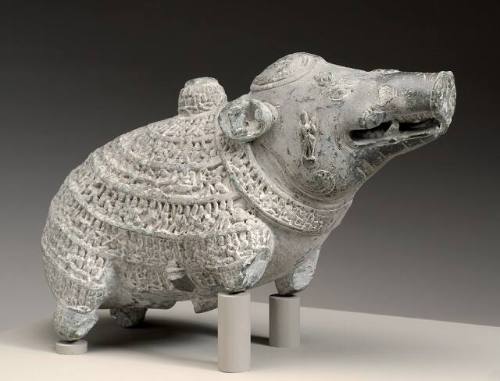
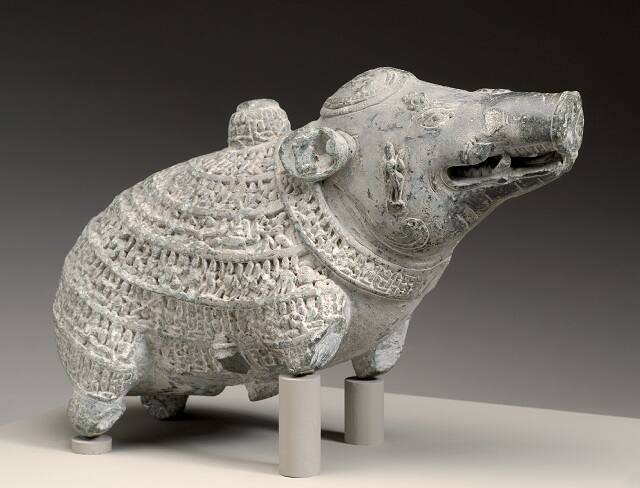
In Hindu belief, the world has suffered from numerous calamities that have threatened its existence. In this sculpture, Varaha, the boar incarnation, or avatar, of the god Vishnu, rescues the earth after it is flooded by a demon.
Rooting beneath the water, Varaha hooks the earth with his tusk and retrieves it. The damaged left jaw of this sculpture once supported the earth, which was personified as a small goddess figure. This particular form of the god is known as Yajna Varaha. Yajna Varaha is covered with a multitude of figures, as the great sages of the world seek refuge in the bristles of his coat.
With Nasli Heeramaneck (1902–1971), New York, by April 4, 1929 [1];
His sale, Rare Asiatic Art: The Heeramaneck Collection, American Art Association, Inc., New York, April 4-5, 1929, lot 264;
With C. Edward Wells Objects of Art, Inc., New York, by December 18, 1943-1944 [2];
Purchased from C. Edward Wells Objects of Art, Inc., through Bluett & Sons, London, by The Nelson-Atkins Museum of Art, Kansas City, MO, 1944.
NOTES:
[1] Nasli Heeramaneck was a dealer of Asian and Pre-Columbian art who began working as a dealer in Paris in the 1920s. He moved to New York and ran Heeramaneck Galleries from 1928 to 1964.
[2] Curator of Asian Art Laurence Sickman purchased this sculpture while stationed in the United Kingdom during his military service in World War II. See letter from Bluett & Sons to Sickman, December 21, 1943, Nelson-Atkins Archives, MSS001 Laurence Sickman Papers, box 10, folder 14.
Sickman had not finalized the purchase of this sculpture when he was transferred out of London in February 1944. Due to the subsequent complexities of Bluett having to get approval of Sickman’s offer from C. Edward Wells in New York, and organizing shipping arrangements from England to the United States during wartime, the sculpture did not arrive in Kansas City until November 1944.
Rare Asiatic Art: The Heeramaneck Collection (New York: American Art Association, Inc., 1929), introduction, 94, no. 264, (repro.).
Ross E. Taggart and George L. McKenna, eds., Handbook of the Collections in The William Rockhill Nelson Gallery of Art and Mary Atkins Museum of Fine Arts, Kansas City, Missouri, vol. 2, Art of the Orient, 5th ed. (Kansas City, MO: William Rockhill Nelson Gallery of Art and Mary Atkins Museum of Fine Arts, 1973), 126, (repro.).
Roger Ward and Patricia J. Fidler, eds., The Nelson-Atkins Museum of Art: A Handbook of the Collection (New York: Hudson Hills Press, in association with Nelson-Atkins Museum of Art, 1993), 381, (repro.).
Deborah Emont Scott, ed., The Nelson-Atkins Museum of Art: A Handbook of the Collection, 7th ed. (Kansas City, MO: Nelson-Atkins Museum of Art, 2008), 269, fig. 37, (repro.).