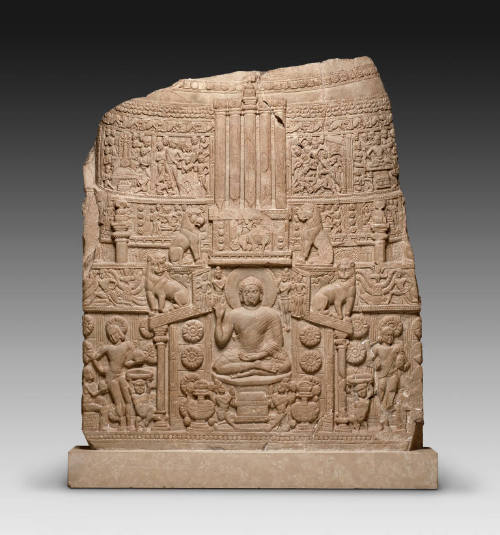
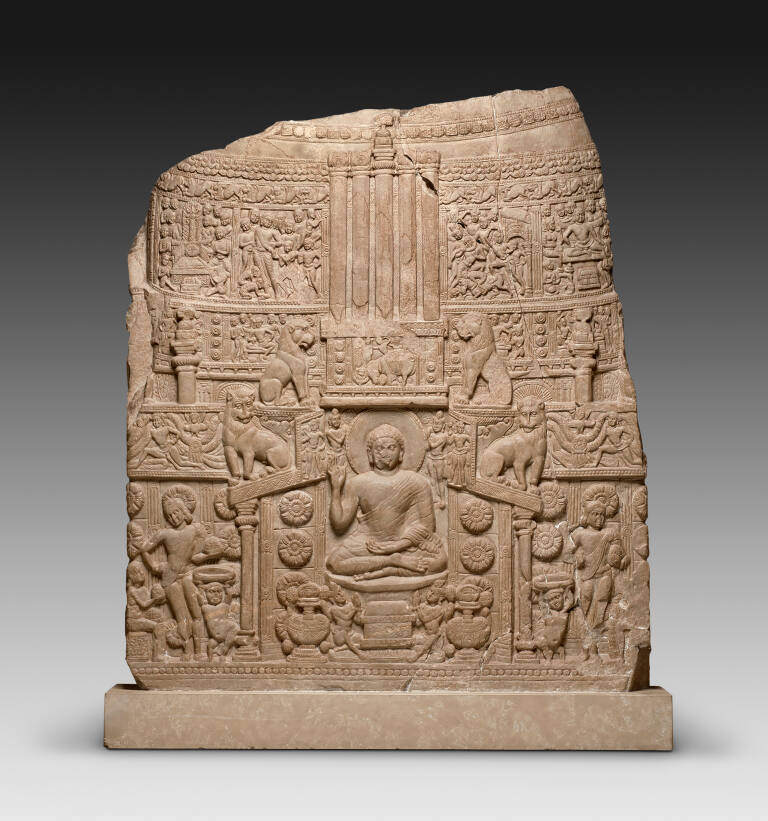
Casing Slab from a Buddhist Stupa
This slab once decorated the exterior of an ornate stupa, a reliquary mound, similar to the example depicted here. The Buddha holds his right hand in the abhaya gesture, offering protection from fear. Immediately above his head, an elephant kneels before a pillar of flame.
This aniconic (non-figurative) representation of the Buddha refers to an incident when the Shakyamuni Buddha tamed an enraged elephant. Two more non-figurative symbols of the Buddha are also depicted: an empty throne at the top left and two footprints below.
Excavated at Gummadidurru (Gummididurru), India, Main Stupa, by Muhammad Hamid Kuraishi, Archaeological Survey of India, from October 20, 1926 [1];
Anonymous owner, by 1949;
Their gift to The Nelson-Atkins Museum of Art, Kansas City, MO, 1949.
NOTES:
[1] This relief appears in the Annual Report of the Archaeological Survey of India 1926-27 as Relief no. 22, having been discovered at Gummadidurru during trial excavations. See Muhammad Hamid Kuraishi, “Trial excavations at Alluru, Gummadidurru and Magarjunikinda,” in Sir John Marshall, ed., Archaeological Survey of India, 1926-27 (Calcutta: Government of India Central Publication Branch, 1930), 154n7, plate XXXVId, (repro.).