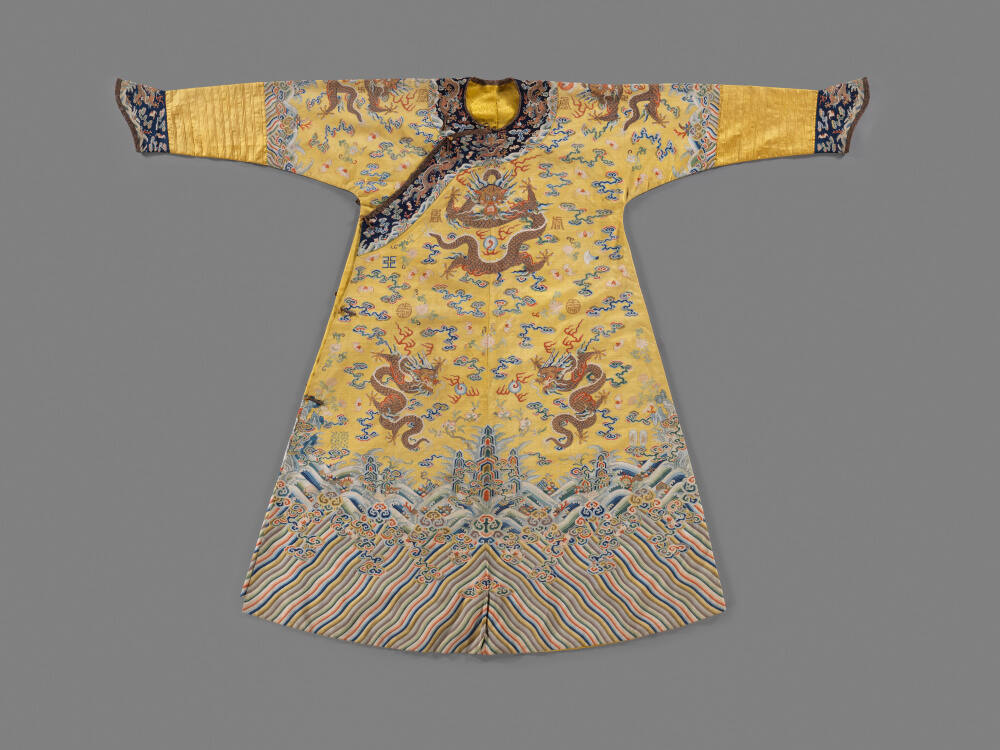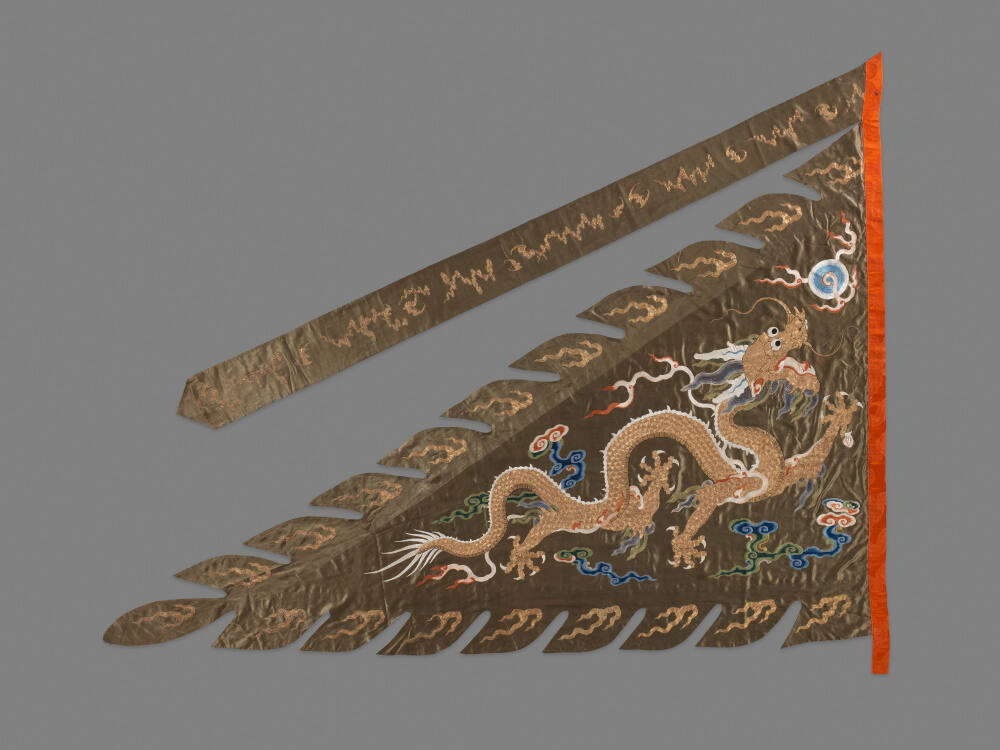
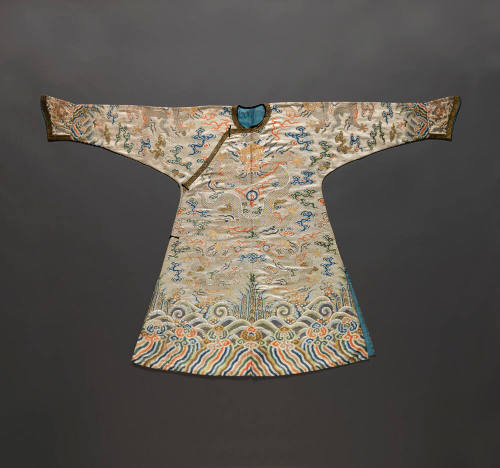
Dragon Robe for Theater
Chinese Textiles, Mills College, 1941.
Costumes from the Forbidden City, Metropolitan Museum of Art, February-July 1945.
The Art of the Forbidden City, Minneapolis Institute of Arts, November 30, 1954 – February 28, 1955.
Emperors, Scholars and Temples: Tastemakers of China’s Ming and Qing Dynasties, The Nelson-Atkins Museum of Art, August 12, 2016 – January, 2017.
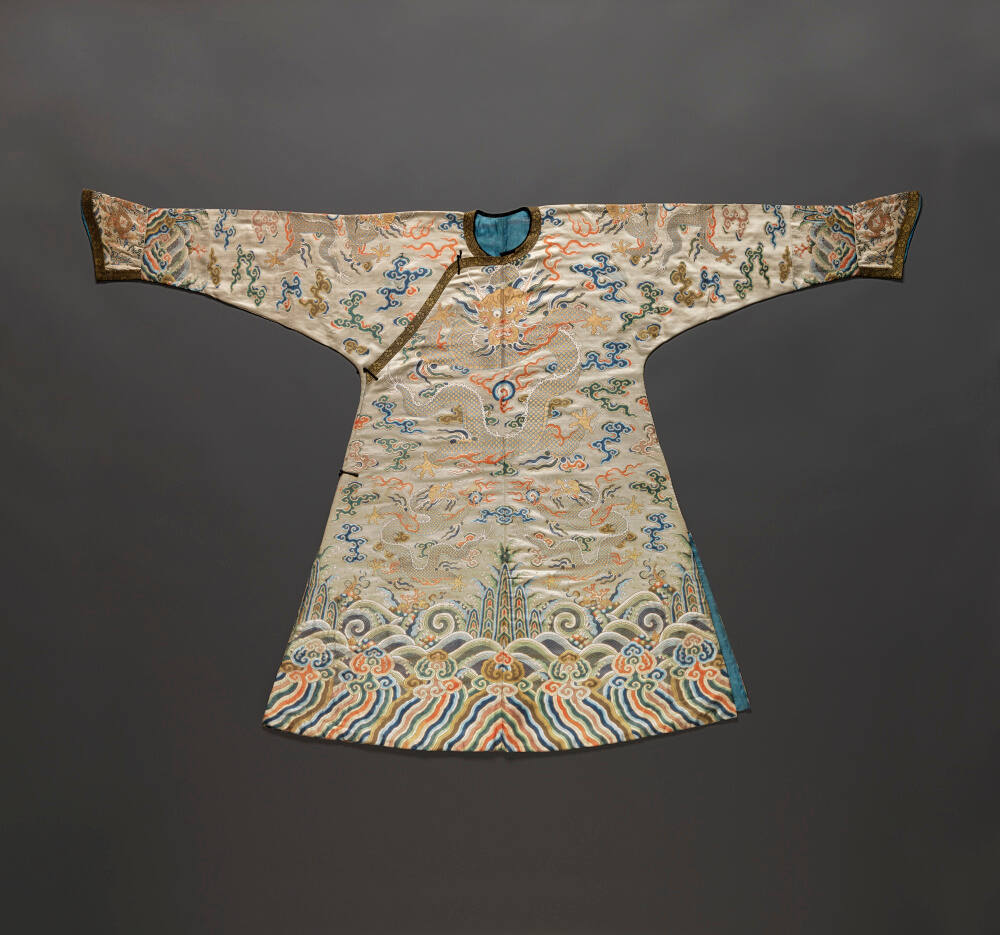
Found in a Qing dynasty (1644–1911) palace, this theater costume featuring nine dragons in designated areas resembles the dragon robes of the Qing court. The plain collar band and the creamy white ground, however, would have excluded it from court dress codes. An actor playing a high-ranking martial character would have donned this robe to entertain the emperor and empress. The fitted sleeves and horse-hoofed cuffs derive from the horse-riding lifestyle of the Manchu, founders of the Qing dynasty.
A temple at Jehol (The Summer Palace), in the old Rehe province, in what is now Chengde, Hebei province;
With Chang Tzu-wen, Hsi Hu Ying, Peking (Beijing), China, by May 10, 1934 [1];
Purchased from Chang Tzu-wen, through Laurence Sickman, by The Nelson-Atkins Museum of Art, Kansas City, MO, 1935.
NOTES:
[1] Nelson-Atkins Archives, Sickman Miscellaneous, box 3, folder Shipping 1934.