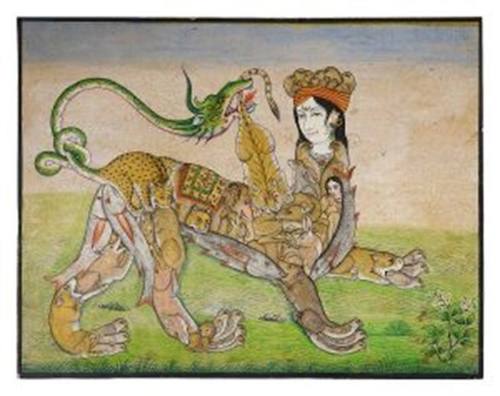
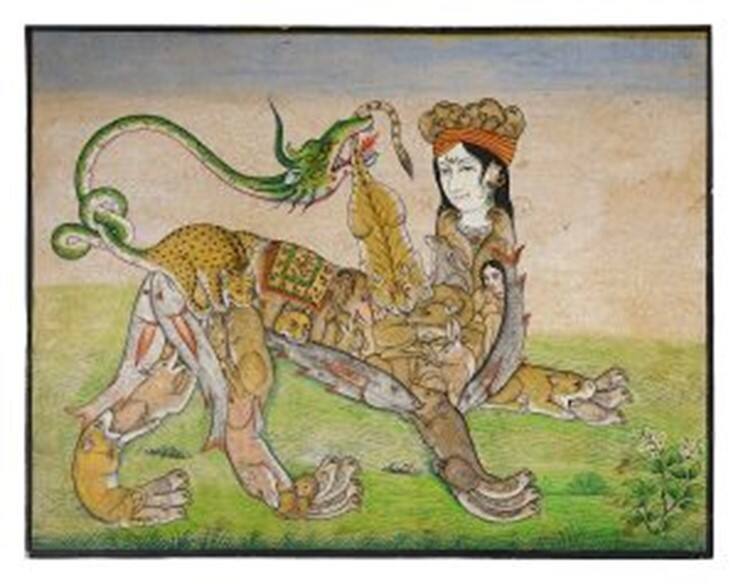
Buraq as a Composite Animal

CultureIndian, Perhaps Delhi, or Pahari, India
Dateca. 1840
MediumOpaque and transparent pigments with gold on paper
DimensionsSheet: 6 × 7 3/4 inches (15.24 × 19.69 cm)
Credit LinePurchase: the Asian Art Acquisition Fund in memory of Laurence Sickman
Object number2026.25.2
On View
Not on view
DescriptionThe rectilinear format painting on paper depicts a large composite animal in a simple landscape, framed in a thin black painted border. The animal is a quadruped with a woman’s head, her forehead is adorned with a crescent moon. This iconography is recognizable as Buraq, the fantastic four-legged, human-faced being that carried the Prophet Muhammed on his Night Journey (Mi’raj) to the heavens from Mecca to Jerusalem. Though early descriptions imagine Buraq as a winged horse and some depictions render the being with a horse or bovine body with hooved feet, this painting follows a tradition that depicts Buraq with a leonine-inspired body .The form of Buraq, here, is created by a composite of forty-four different animals and two human figures, creatively nestled together. Gentle animals--like birds, rabbits, fish, deer, and camels, sit peacefully, in the composition, though some are under threat from attacking predators, like lions, tigers, and leopards. Interesting details include the human figure at Buraq’s chest, the clusters of birds that form her crown and toes, and the brilliant green dragon that extends from her knotted tail to bite the tiger that assaults her. This jewel-like green is different in tone than the rest of the gold and earthly palette, and is likely the result of a modern chemical dye, helping to date this work to around 1840. The landscape setting is spare; indicated by a green ground plane, defined by rows of narrow vertical lines and enlivened by a few sprigs of grass and a flowering plant at the bottom of the page, a wash of white paint marking the horizon, and a line of blue at the top indicating the sky.

The words “Kangra 1800” are written in pencil and "Jana and Jhaplijal" in purple ink, on the verso.
Provenance

John (1928-2024) and Berthe Gilmore Ford, Baltimore;

Private collection, New York, 2012-2026;

Purchased by the Nelson-Atkins Museum of Art through Oliver Forge & Lynch Ltd., 2026.

Published References

Forge and Lynch. Luminaries, Myth and Fantasy in Indian and Persian Painting. Asia Week New York Catalogue, March, 2026, cat. 41

Information about a particular artwork or image, including provenance information, is based upon historic information and may not be currently accurate or complete. Research on artwork and images is an ongoing process, and the information about a particular artwork or image may not reflect the most current information available to the Museum. If you notice a mistake or have additional information about a particular artwork or image, please e-mail provenance@nelson-atkins.org.


Plate
Worcester Royal Porcelain Company
1770-1775
35-3/6
Big Night
Pitín
2011
2023.49.2
overall side A
ca. 1900
2013.58.2
Sash/Belt
20th century
F93-33/9 B
Sash/Belt
20th century
F93-33/9 A
Emblem of the Leopard Society
early-mid-20th century
2005.36.A-D
Reverse of a Mirror
Three Kingdoms (220-265 C.E.)
33-1535
Façade of a Mortuary Bed
5th century C.E.
31-136/23
The Return of the Sun
Kenojuak Ashevak
1961
F96-50
Sleeping Bacchus
Anne Louis Girodet-Trioson
1790/1791
F98-2
Woman's Strip-woven Wrapper
early 20th century
96-36/3