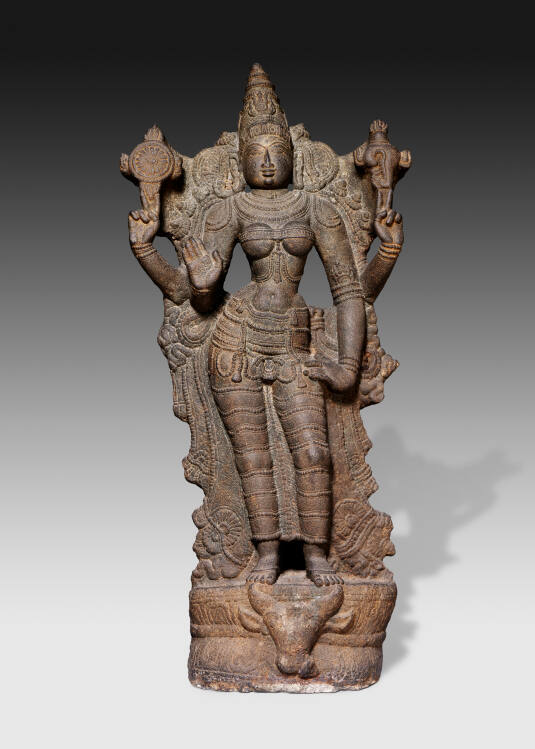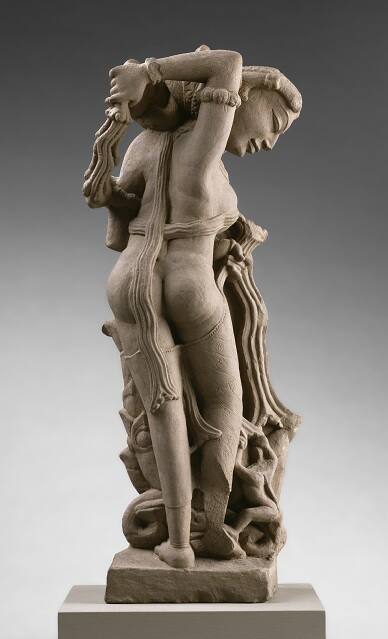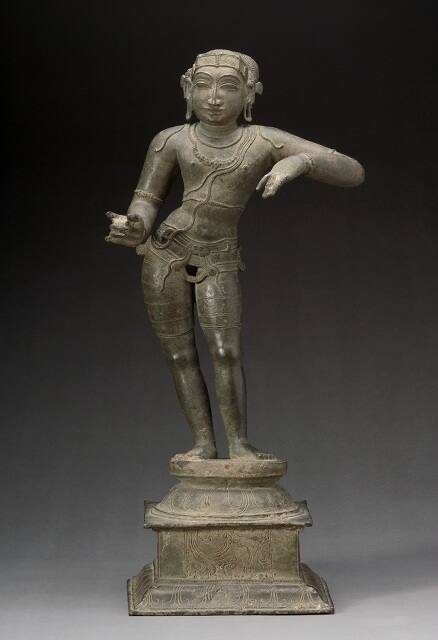
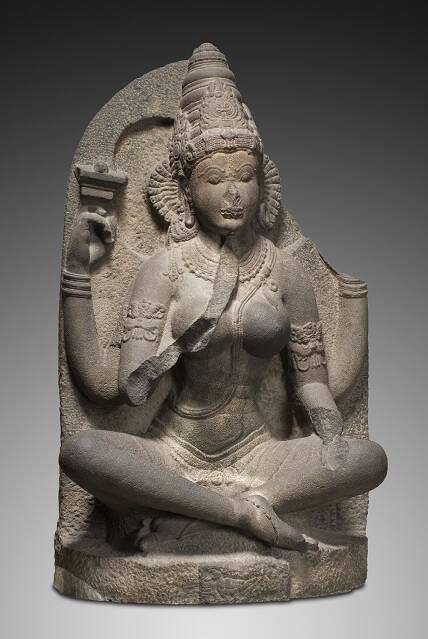
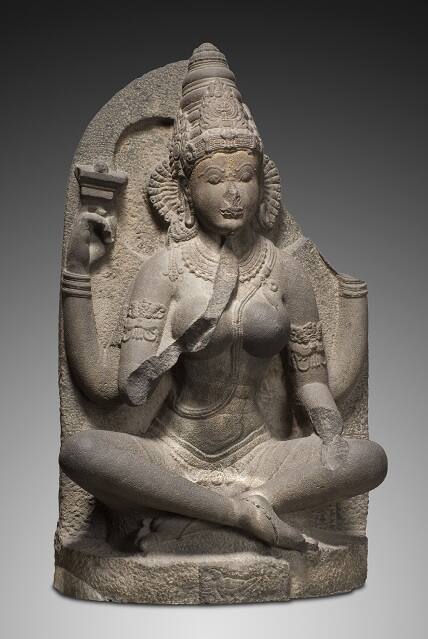
A Yogini
- 227
Exhibition History
An Exhibition of the Sculpture of Greater India, C. T. Loo and Co., New York, 1942, no. 36 as Sapta-Matrika.
Acquired by N. Tangavelou Pillai, with Gabriel Jouveau-Dubreuil (1885-1945), in Conjeevaram, Tamil Nadu, India, for C. T. Loo & Co., Paris and New York, 1925-1926 [1];
With C. T. Loo & Co., New York, 1926-1944 [2];
Purchased from C. T. Loo & Co. by The Nelson-Atkins Museum of Art, Kansas City, MO, 1944.
NOTES:
[1] Gabriel Jouveau-Dubreuil was a French archaeologist and a professor at the Collège Colonial in Pondicherry, India. In 1924, he entered into an agreement with the Musée Guimet in Paris and the dealer C. T. Loo, in which Jouveau-Dubreuil would source objects in India for the Guimet and Loo. N. Tangavelou Pillai was Jouveau-Dubreuil’s principal agent in these acquisitions. In a report of their activities that accompanied a letter to Musée Guimet curators Joseph Hackin (1886-1941) and René Grousset (1885-1952) dated February 17, 1926, Tangavelou Pillai describes the acquisition of a group of yogini sculptures, one of which was the Nelson-Atkins example, over a period of several months beginning in August 1925. See “Résumé des opérations faites par M. Tangavelou pour essayer d’obtenir des antiquités pour M. Loo,” Gabriel Jouveau-Dubreuil Archives, Musée Guimet, Paris.
[2] An image of the Yogini was first published in Rene Grousset’s 1931 publication The Civilizations of the East, which lists it with seven other examples (figures 88-89) as the “Property of Monsieur C. T. Loo.” Loo loaned three of these sculptures to the Nelson-Atkins for the museum’s opening exhibition in December 1933; all three were sent to Kansas City from other museums where they had been under consideration: one from the Detroit Institute of Arts and two from the Art Institute of Chicago. These three sculptures are today in the Nelson-Atkins (the present object), the Smithsonian’s National Museum of Asian Art (no. S1987.905), and the Detroit Institute of Arts (no. 57.88). It is unclear exactly which of these three loaned sculptures came to the Nelson-Atkins from Detroit or Chicago, as photographs from the time have not been located. Even C. T. Loo’s records were not entirely clear. His assistant, Marion W. Riepe, wrote to Paul Gardner, Nelson-Atkins Director, November 28, 1933: “Your museum has three mothers but as Mr. Loo has put numbers on very few of his Indian pieces it is impossible to know whether a description fits unless it can be checked with the actual piece.” Riepe included descriptions of two Yogini sculptures she thought were at the Nelson-Atkins, but they more closely match sculptures that are today at the Minneapolis Institute of Art (no. 60.21) and the Royal Ontario Museum (no. 956.181). The sculptures that are today in the Smithsonian and the Detroit Institute of Arts remained on loan to the Nelson-Atkins from 1933 until August 1950, when they were returned to Loo. See Nelson-Atkins Archives, RG01/01, Director’s Office Records – Gardner, Box 1, Folder 28 and the C. T. Loo & Co. stock card, C. T. Loo/Frank Caro archive, Musée Guimet, Paris, copies in Nelson-Atkins curatorial files.
Rene Grousset, The Civilizations of the East, vol. 2, trans. by Catherine Alison Phillips (New York: Alfred A. Knopf, Inc., 1931), 28, 155, fig. 88, (repro.).
C. T. Loo, An Exhibition of the Sculpture of Greater India: a Fully Illustrated Catalogue, exh. cat. (New York: C. T. Loo & Co., 1942), 34-35, 59, (repro.).
Douglas Barrett, “The Temple of Virattanesvara,” in The Heritage of Indian Art, no. 2 (Bombay: Bhulabhai Memorial Institute, 1958), 6, pl. 21, (repro.).
Ross E. Taggart, ed., Handbook of the Collections in the William Rockhill Nelson Gallery of Art and Mary Atkins Museum of Fine Arts, 4th ed. (Kansas City, MO: William Rockhill Nelson Gallery of Art and Mary Atkins Museum of Fine Arts, 1959), 228, (repro.).
Ross E. Taggart and George L. McKenna, eds., Handbook of the Collections in The William Rockhill Nelson Gallery of Art and Mary Atkins Museum of Fine Arts, Kansas City, Missouri, vol. 2, Art of the Orient, 5th ed. (Kansas City, MO: William Rockhill Nelson Gallery of Art and Mary Atkins Museum of Fine Arts, 1973), 124, (repro.).
Vidya Dehejia, Yogini Cult and Temples: A Tantric Tradition (New Delhi: National Museum, 1986), 180-82, (repro.).
Roger Ward and Patricia J. Fidler, eds., The Nelson-Atkins Museum of Art: A Handbook of the Collection (New York: Hudson Hills Press, in association with Nelson-Atkins Museum of Art, 1993), 384, (repro.).
Richard L. Anderson, Calliope’s Sisters: A Comparative Study of Philosophies of Art, 2nd ed. (Upper Saddle River, NJ: Pearson Prentice Hall, 2004), 199, fig. 8-3, (repro.).
Deborah Emont Scott, ed., The Nelson-Atkins Museum of Art: A Handbook of the Collection, 7th ed. (Kansas City, MO: Nelson-Atkins Museum of Art, 2008), 264, fig. 22, (repro.).
Padma Kaimal, Scattered Goddesses: Travels with the Yoginis (Ann Arbor, MI: Association for Asian Studies), 4, 8-9, 11, 14-15, 17-19, 21, 24, 26, 30, 44, 55, 88-89, 91-94, 97-98, 135-36, 143, 145, 148-149, 165-68, 184-88, 209, fig. 3, fig. 21, fig. 32, figs. 32a-c, fig. 87, fig. 89, fig. 134, (repro.).
Nelson-Atkins Museum of Art and Kimberly Masteller, Masterworks from India and Southeast Asia: the Nelson-Atkins Museum of Art (Kanas City, Missouri: The Nelson-Atkins Museum of Art in association with University of Washington Press, 2016), 63-63, (repro.).