
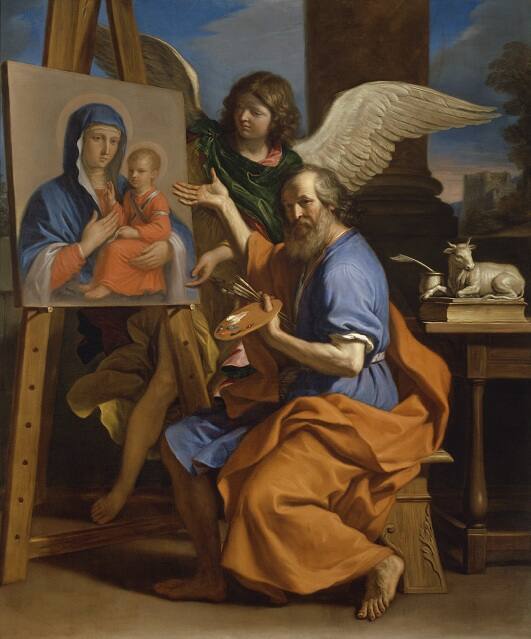
Saint Luke Displaying a Painting of the Virgin
Framed: 101 3/16 × 85 5/16 inches (257.02 × 216.69 cm)
- 114
The Age of Correggio and the Carracci: Emilian Painting of the Sixteenth and Seventeenth Centuries, Pinacoteca Nazionale, Bologna, September 10-November 10, 1986; National Gallery of Art, Washington, D.C., December 19, 1986-February 16, 1987; The Metropolitan Museum of Art, New York, March 26-Mary 24, 1987, no. 168.
A Bountiful Decade: Selected Acquisitons, 1977-1987, The Nelson-Atkins Museum of Art, Kansas City, Missouri, October 14-December 6, 1987, no. 55.
Giovanni Francesco Barbieri, Il Guercino, 1591-1666, Richard L. Feigen & Co., New York, March 12-April 25, 1992, no. 12.
Commissioned from the artist for the church of San Francesco, Reggio Emilia, July 24, 1651-at least June 1721 [1];
Probably The Honorable John Spencer (1708-1746), by 1746;
Probably by descent to his son John (1734-1783), 1st Earl Spencer, Althorp, Northamptonshire, 1746-1783 [2];
By descent to the Earls Spencer, Althorp, Northamptonshire, 1783-ca. 1983;
With P. & D. Colnaghi, London, on joint account with Richard L. Feigen & Co., New York, by 1983;
Purchased from Colnaghi and Feigen by The Nelson-Atkins Museum of Art, Kansas City, MO, 1983.
NOTES:
[1] The commission from the friars of San Francesco was brokered by Aurelio Zanelletti, a nobleman from Reggio who was a friend of the artist and collector of his paintings. The transaction between the friars and Zanelletti was recorded on a deed drawn up by notary Filippo Suzzari dated July 24, 1651 [see Archivio di Stato Reggio Emilia, Notarile, b. 2599, n. 131]. The painting’s price was 240 ducats; the friars paid Zanelletti a deposit and additional installments over the next two years.
On April 17, 1653, in response to an inquiry from the friars about the painting’s progress, Guercino replied that the painting had been completed some time ago. He had notified Zanelletti that it was ready to be collected, but he had responded that the payment was not yet ready. The friars’ discovery that Zanelletti had not passed on their payments to Guercino apparently prompted an inquiry. It is unclear whether Zanelletti was waiting for the friars to submit the remaining balance (thus far they had only paid two-thirds) before paying the artist, or if he withheld the funds for another reason, but a deed dated February 12, 1655 records that Zanelletti returned to the friars all the money they had paid him [see Archivio di Stato Reggio Emilia, Notary Benedetto Ferrari, in Notarile, b. 2472, n. 188].
Three days later, on February 15, 1655, the artist’s Book of Accounts records the receipt of 240 ducats from Father Impolito Montagioli, president of the monastery of San Francesco, in full payment for the painting, which was collected by Montagioli from Guercino’s studio in Bologna the same day [see Libro dei conti, Bibliotheca Comunale dell’Archiginnasio, Bologna, ms. B 331, fol. 49 v.]. The circumstances surrounding the painting’s commission are detailed by Alberto Cadoppi in “‘Ad effectum fieri facendi unam tabullam picturae ab excellentissimo Domino Francisco Barberio e Cento vulgariter dicto il Guerzino Pictore famosissimo’. Nuovi documenti sul San Luca del Guercino del Nelson-Atkins Museum, un tempo in San Francesco a Reggio Emilia,” About Art Online (June 15, 2026).
By the early 18th century, the condition of the church of San Francesco had deteriorated to the point that the decision was made to demolish and rebuild the entire church. The demolition began in 1709, and Saint Luke was placed in storage. By the spring of 1721, following the decision to dedicate the new church to Saint Francis rather than Saint Luke, the friars determined to sell the painting. Permission to do so was granted by the College of Cardinals in Rome on May 23, 1721, and seconded by the Procurator General of the Conventual (Franciscan) Order on June 7, 1721 [see Archivio di Stato Modena, Corporazioni sopprese, Francescani di Reggio, Filza 3036 (formerly 2438), n.p.]. For an in-depth discussion of this painting’s provenance, see Eliot W. Rowlands, The Collections of the Nelson-Atkins Museum of Art: Italian Paintings 1300–1800 (Kansas City, MO: Nelson-Atkins Museum of Art, 1996), 300-306.
[2] The painting is included in a 1750 inventory of the Spencer collection, Hertfordshire Record Office, County Hall, Hertford, no. SG13 8DE, published in K. J. Garlick, “A Catalogue of the Pictures at Althorp,” The Walpole Society 45 (1974-76), 34, no. 248.
C.C. Malvasia, Felsina pittrice, vite de pittori bolognesi, ed. G. P. Zanotti, vol. 2 (1678; repr. Bologna, 1841), 269, 336.
[Jacopo Alessandro Calvi], Notizie della vita, e delle opera del Cavaliere Gioan Francesco Barbieri detto il Guercino da Cento (Bologna: Tipografia Marsigli, 1808), 139.
Thomas Frognall Dibdin, Aedes Althorpianae, or an Account of the Mansion, Books, and Pictures at Althorp; the Residence of George John, Earl Spencer, K.G., vol. 1 (London: W. Nicol, 1822), 276.
Johann David Passavant, Kunstreise durch England und Belgien (Frankfurt: Siegmund Schmerber, 1833), 191.
Johann David Passavant, Tour of a German Artist in England, vol. 2 (London: Saunders and Otley, 1836), 34
Gustav Friedrich Waagen, Treasures of Art in Great Britain, vol. 3 (London: John Murray, 1854), 456.
Giuseppe Campori, Gli artisti italiani e stranieri negli stati estensi: Catalogo critico corredato di documenti inediti (Modena: Tipofrafia della R.D. Camera, 1855), 50.
Gaetano Atti, Intorno alla vita e alle opera di Gianfrancesco Barbieri, detto il Guercino da Cento: Commentario (Rome: Tipografia delle Scienze Matematiche e Fisiche, 1861), 116.
Ulrich Thieme and Felix Becker, eds., Allgemeines Lexikon der bildenden Künstler, vol. 15 (Leipzig: E.A. Seemann, 1922), 219.
Philip Toynbee, ed., “Horace Walpole’s Journals of Visits to Country Seats…1760,” The Walpole Society 16 (1927-28): 32, as by Francesco Albani.
Dorothy Klein, St. Lukas als Maler der Maria: Ikonographie der Lukas-Madonna (Berlin: Oskar Schloss, 1933), 87, 117n401.
Andor Pigler, Barockthemen: eine Auswahl von Verzeichnissen zur Ikonographie des 17. und 18. Jahrhunderts, vol. 1 (Budapest: Verlag der Ungarischen Akademie der Wissenschaften, 1956), 444.
Nefta Barbanti Grimaldi, Il Guercino: Gian Francesco Barbieri, 1591-1666 (Bologna: Edizione G.R., 1968), 111.
Kenneth Garlick, “A Catalogue of Pictures at Althorp,” The Walpole Society 45 (1974-1976): 34.
Nerio Artioli and Elio Monducci, Dipinti “Reggiani” del Bonone e del Guercino, exh. cat. (Reggio Emilia: Ente Provinciale per il Turismo, 1982), 115-17, 176-78, (repro.).
“Italian Masterpiece is Added to the Collection,” Calendar of Events (The Nelson-Atkins Museum of Art) (June 1984): unpaginated, (repro).
Donald Hoffman, “Guercino fills a gap at gallery,” The Kansas City Star (June 3, 1984): 11D, (repro.).
“Fellows View the Guercino,” The Independent Magazine (June 16, 1984): unpaginated, (repro.).
“Seventeenth-Century Paintings: Recent Acquisitions and Conservation in American and European Museums,” The Burlington Magazine 126 (1984): 320, (repro.).
Giovanni Fallani, ed., L’arte sacra nei Ducati Estensi: Atti della II Settimana dei Beni storico-artistici della Chiesa nazionale negli Antichi Ducati Estensi, Ferrara, 13-18 settembre 1982 (Ferrara: Stabilimento Artristico Tipografico, 1984), 365.
M. Therese Southgate, “The Cover: Giovanni Francesco Barbieri, St. Luke Displaying a Painting of the Virgin, 1652,” The Journal of the American Medical Association 256, no. 14 (October 10, 1986): 1841, (repro.).
The Age of Correggio and the Carracci: Emilian Painting of the Sixteenth and Seventeenth Centuries (Washington, D.C.: National Gallery of Art, 1986), 478-481.
John Russell, “Italy’s Heralds of the Baroque,” review of The Age of Correggio and the Carracci: Emilian Painting of the Sixteenth and Seventeenth Centuries, The New York Times (March 22, 1987): sec. 2, pp. 34.
Roger Ward, ed., A Bountiful Decade: Selected Acquisitions, 1977-1987, exh. cat. (Kansas City, MO: Nelson-Atkins Museum of Art, 1987), 130-131, (repro.).
Luigi Salerno and Denis Mahon, I dipinti del Guercino (Rome: Bozzi, 1988), no. 300, pp. 368-89, (repro.).
Ellen R. Goheen, The Collections of the Nelson-Atkins Museum of Art (New York: Harry N. Abrams, 1988), 60-61, (repro.).
John Walsh, “Jan Steen’s Drawing Lesson and the Training of Artists,” Source: Notes in the History of Art 8/9, no. 4/1 (Summer-Fall 1989): 83, 86n22.
Denis Mahon, The Drawings of Guercino in the Collection of Her Majesty the Queen at Windsor Castle (Cambridge: Cambridge University Press, 1989), 129.
Olivier Bonfait, “Il pubblico del Guercino: Richerche sul mercato dell’arte nel XVII secolo a Bologna,” Storia dell’Arte, no. 68 (1990): 83.
Leo Steinberg, “Steen’s Female Gaze and Other Ironies,” Artibus et Historiae 11, no. 22 (1990): 126n30.
Roger Ward, “Selected Acquisitions of European and American Paintings at The Nelson-Atkins Museum of Art, Kansas City, 1986-1990,” Burlington Magazine 133, no. 1055 (February 1991): 156.
Simon Blow, “A Tale of Two Houses,” Connoisseur 221 (1991): 63.
Michael Helson et al., Guercino in Britain: Paintings from British Collections, exh. cat. (London: National Gallery Publications and the Burlington Magazine Publications, 1991), 4, 6-7, (repro.).
David M. Stone, Guercino: Catalogo complete dei dipinti (Florence: Cantini, 1991), no. 287, pp. 294-295, (repro.).
Carel van Tuyll van Serooskerken, Guercino (1591-1666): Drawings from Dutch Collections, exh. cat. (S’Gravenhage: Gary Schwartz, 1991), 134.
Tom Henry, review of Guercino (1591-1666): Drawings from Dutch Collections, by Carel van Tuyll van Serooskerken, The Burlington Magazine 133 (July 1991): 476.
Advertisement, The Burlington Magazine 134 (1992): ii, (repro.).
Arthur C. Danto, Mark Tansey: Visions and Revisions (New York: Harry N. Abrams, 1992), 8-9, (repro.).
Giovanni Francesco Barbieri, Il Guercino, 1591-1666, exh. cat. (New York: Richard L. Feigen, 1992), 42-44, (repro.).
Nicholas H. J. Hall, ed., Colnaghi in America: A Survey to Commemorate the First Decade of Colnaghi New York (New York: Colnaghi, 1992), 70-71, 129, (repro.).
Michael Churchman and Scott Erbes, High Ideals and Aspirations: The Nelson-Atkins Museum of Art, 1933-1993 (Kansas City, MO: Nelson-Atkins Museum of Art, 1993), 108.
Roger Ward and Patricia J. Fidler, eds., The Nelson-Atkins Museum of Art: A Handbook of the Collection (New York: Hudson Hills Press, in association with Nelson-Atkins Museum of Art, 1993), 169, (repro.).
Andrea Emiliani et al., La Pittura in Emilia e in Romagna: Il seicento, vol. 2 (Milan: Electa, 1994), 392.
Jared Jackson, Art: A comparative study (Dubuque, Iowa: Kendall/Hunt Publishing, 1994), 211-212, (repro.).
Elliot W. Rowlands, The Collections of The Nelson-Atkins Museum of Art: Italian Paintings, 1300-1800 (Kansas City, MO: Nelson-Atkins Museum of Art, 1996), 21, 297-306, (repro.).
Jana Zapletalová, “A new Guercino: Copy or Replica?” Institute of the History of Art of the Academy of Sciences of the Czech Republic 59 (2011): 299, 300,302n20, 302n21, 302n36, 344, (repro.).
Ralph Dekoninck and Ingrid Falque, Revivals or Survival? Resurgences of the Icon from the 15th Century to the Present Day (Brussels: Silvana Editoriale and Bozar Books, 2023).
Alberto Cadoppi, “‘Ad effectum fieri fandi unam tabullam picturae ab excellentissimo Domino Francisco Barberio and Cento vulgariter dicto il Guerzino Pictore very famous:’ New documents on Guercino's San Luca from the Nelson-Atkins Museum, once in San Francesco in Reggio Emilia,” About Art Online (June 15, 2026): https://www.aboutartonline.com/ad-effectum-fieri-facendi-unam-tabullam-picturae-ab-excellentissimo-domino-francisco-barberio-e-cento-vulgariter-dicto-il-guerzino-pictore-famosissimo-nuovi-documenti-sul-san-luca-del-guer/.