
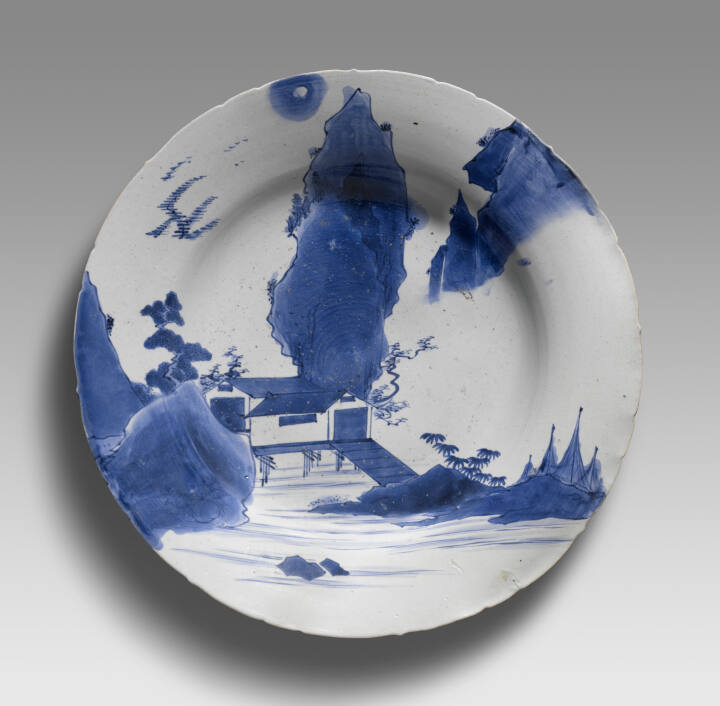
Large Dish with Landscape Design
- 205
Compositions that juxtapose towering mountains and flowing water became a common design for Japanese ceramics in the 1600s when a local supply of kaolin clay—the basis for porcelain—was discovered with the aid of Korean potters. Before then, porcelain was exclusively produced in China and Korea, and Japanese artists drew inspiration from Chinese decorations that frequently featured landscapes.
With S. Yabumoto, Ltd., Tokyo, by 1964;
Purchased from S. Yabumoto, Ltd., by N. V. Hammer, Inc., New York, no. C496, by November 17, 1964 [1];
Purchased from N. V. Hammer, Inc. by Karen Dean Bunting (1912-1981), Shawnee Mission, KS, November 24, 1964-1981 [2];
Her bequest to The Nelson-Atkins Museum of Art, Kansas City, MO, 1981.
NOTES:
[1] According to a letter from N. V. Hammer, Inc. to Karen Bunting, November 17, 1964, Nelson-Atkins curatorial files, Hammer acquired this dish from Yabumoto “when I was last in Japan.”
[2] The N. V. Hammer, Inc. invoice is in the Nelson-Atkins curatorial files.
Nelson-Atkins Museum of Art, Ceramics: highlights from the collection of the Nelson-Atkins Museum of Art (The Nelson-Atkins Museum of Art Museum, 2016), 30.
Richard S. Cleveland, 200 Years of Japanese Porcelain, exh. cat. (Saint Louis: City Art Museum of St. Louis, 1970) no. 50, 64-65, text 159.