
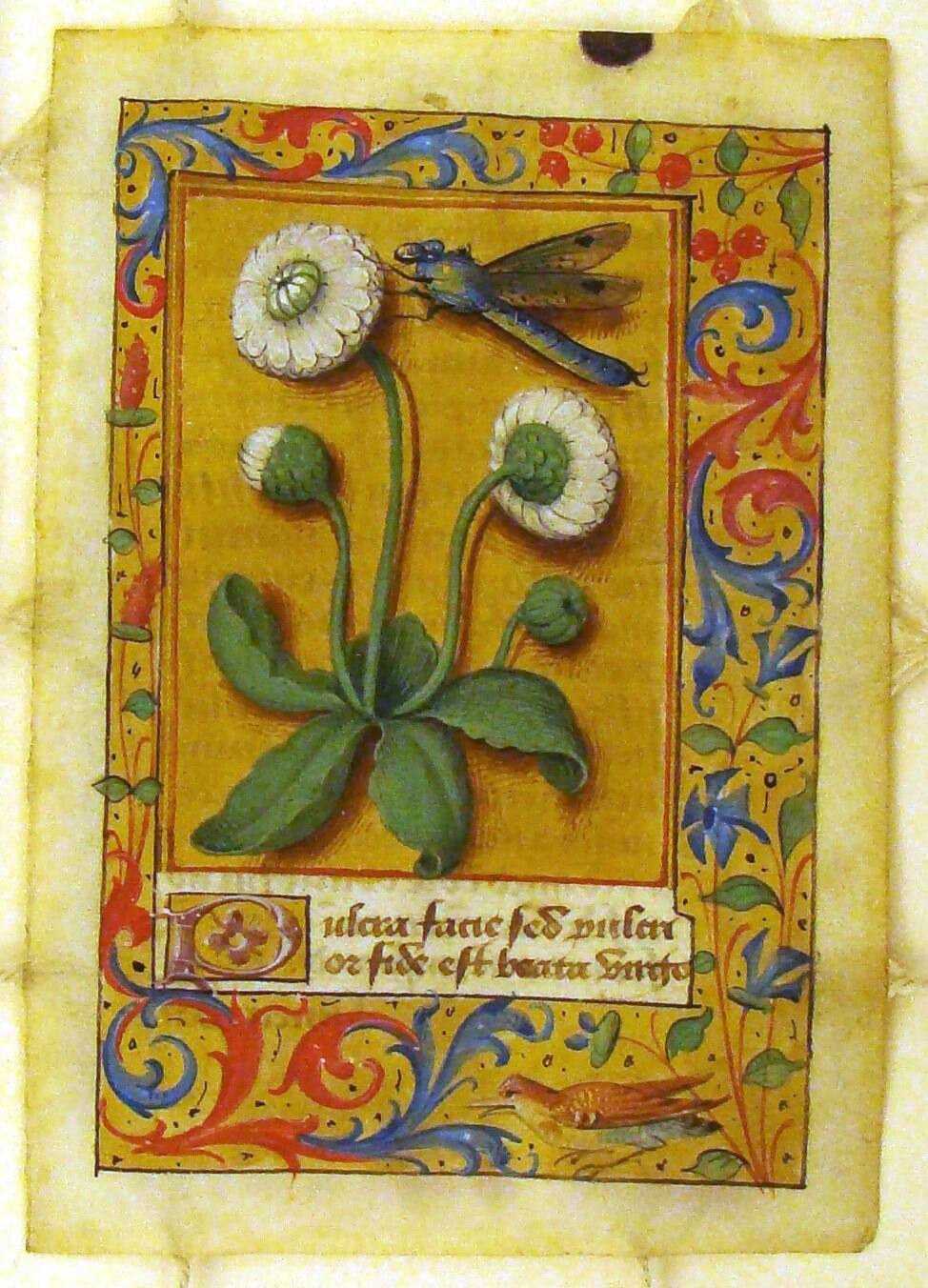
Botanical Studies: White Daisy
- 130
The Treasury: the Splendor of Liturgical Objects, The Nelson-Atkins Museum of Art, Kansas City, MO, August 21, 2005–February 8, 2006; August 25, 2010–February 24, 2011; August 19, 2015–March 13, 2016, June 24–December 14, 2021, no cat.
By the 1500s, floral decoration in manuscripts was a centuries-old practice. These intricate works of art, made in Tours, France—just 175 miles from Giverny and nearly 300 years before Monet’s Water Lilies—formed part of a private devotional book for Queen Claude of France (reigned 1514– 1524). Featuring naturalistic flowers and insects, the illustrations accompanied inscriptions offering prayers to female Christian saints.
Medieval flowers carried layered and sometimes conflicting meanings. Daisies symbolized purity, innocence, and renewal, while feverfew, a daisylike bloom, embodied virginity and saintly virtues. Primroses heralded youth and love. The strawberries along the borders symbolized
Jesus’s mother, the Virgin Mary, and butterflies, dragonflies, and the phoenix suggested resurrection.
Henri Baderou (1910-1991), France, by February 17, 1956;
Purchased from Baderou by Durlacher Brothers, New York, stock no. 603D, February 17-September 13, 1956 [1];
Purchased from Durlacher Brothers by Milton McGreevy (1903–1980), Shawnee Mission, KS, September 13, 1956-1980;
His bequest to The Nelson-Atkins Museum of Art, Kansas City, MO, 1981.
NOTES:
[1] Getty Research Library, Los Angeles, Durlacher Brothers Records, Box 14, Ledger 1937-1966, copy in Nelson-Atkins curatorial files.