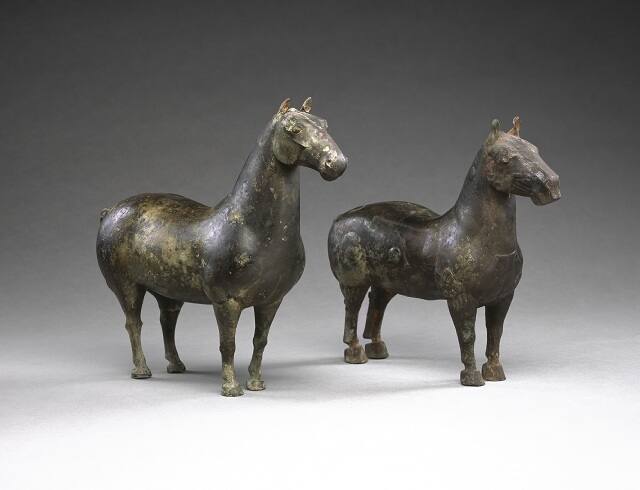
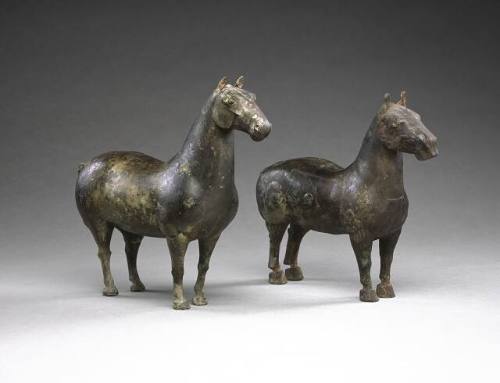
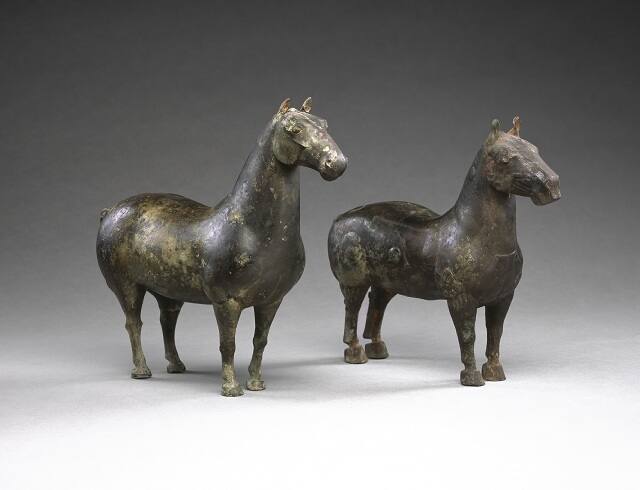
Figure of a Horse
- 232
The Horse in Art, Fogg Museum, Cambridge, Massachusetts, 1938.
The Horse in Art, Fine Arts Gallery of San Diego, January 18-February 24, 1963.
Yamanaka & Co., New York, 1932;
Purchased from Yamanaka & Co. by The Nelson-Atkins Museum of Art, Kansas City, MO, 1932.
Master Bronzes (Buffalo, New York: Albright Gallery, Feb.1937), no.25,ill, ( repro.).
Erdberg Consten, Das Alte China (Stuttgart: G. Kilpper, 1958), pl. 56, top, (repro.).
Laurence C.S. Sickman, Art and Architecture of China (London, Connoisseur, May, 1956), 206, il. , pl. 9. (repro.).
Ross E. Taggart, ed., Handbook of the Collections in the William Rockhill Nelson Gallery of Art and Mary Atkins Museum of Fine Arts, 4th ed. (Kansas City, MO: William Rockhill Nelson Gallery of Art and Mary Atkins Museum of Fine Arts, 1959), 174, (repro.).
Capolavori Nei Secoli, no. 25 (Milano, May 12, 1962):19,(repro.).
Mario Bussagli, Chinese bronzes (Milano, 1966), pl.46. p.103 col. Art news, (Dec. 20, 1930):18, (repro.).
Jerome R. Reich, & Mark M. Krug, Building the Modern World (New York: Harcourt, Brace & World, 1969),(repro.).
George Savage, Concise history of Bronzes (London: Thames and Hudson, 1969, 1968),113 pl. 95, (repro.).
Hugo Munsterberg, Sculpture of the Orient (New York: Dover Publications, 1972), pl. 64, (repro.).
Ross E. Taggart, George L. McKenna, and Marc F. Wilson, eds., Handbook of the Collections in The William Rockhill Nelson Gallery of Art and Mary Atkins Museum of Fine Arts, Kansas City, Missouri, vol. II, Art of the Orient. (Kansas City, MO: William Rockhill Nelson Gallery of Art and Mary Atkins Museum of Fine Arts, 1973), 16, (repro.).
Editorial, “The lure of Ancient China,” Apollo, special issue for the Asian art collection in the Nelson-Atkins Museum of Art, Vol. XCVII, no. 133 (March 1973): 214, fig. 6, (repro.).
William Watson, Art of Dynastic China, no.251 (New York: Abrams, 1981, 1979): 389, (repro.).
Roger Ward and Patricia J. Fidler, eds., The Nelson-Atkins Museum of Art: A Handbook of the Collection (New York: Hudson Hills Press, in association with Nelson-Atkins Museum of Art, 1993), 281, (repro.).
Deborah Emont Scott, ed., The Nelson-Atkins Museum of Art: A Handbook of the Collection, 7th ed. (Kansas City, MO: Nelson-Atkins Museum of Art, 2008):299, fig. 51, (repro.).