
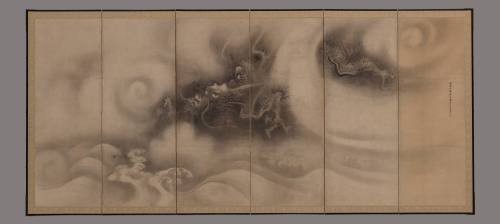
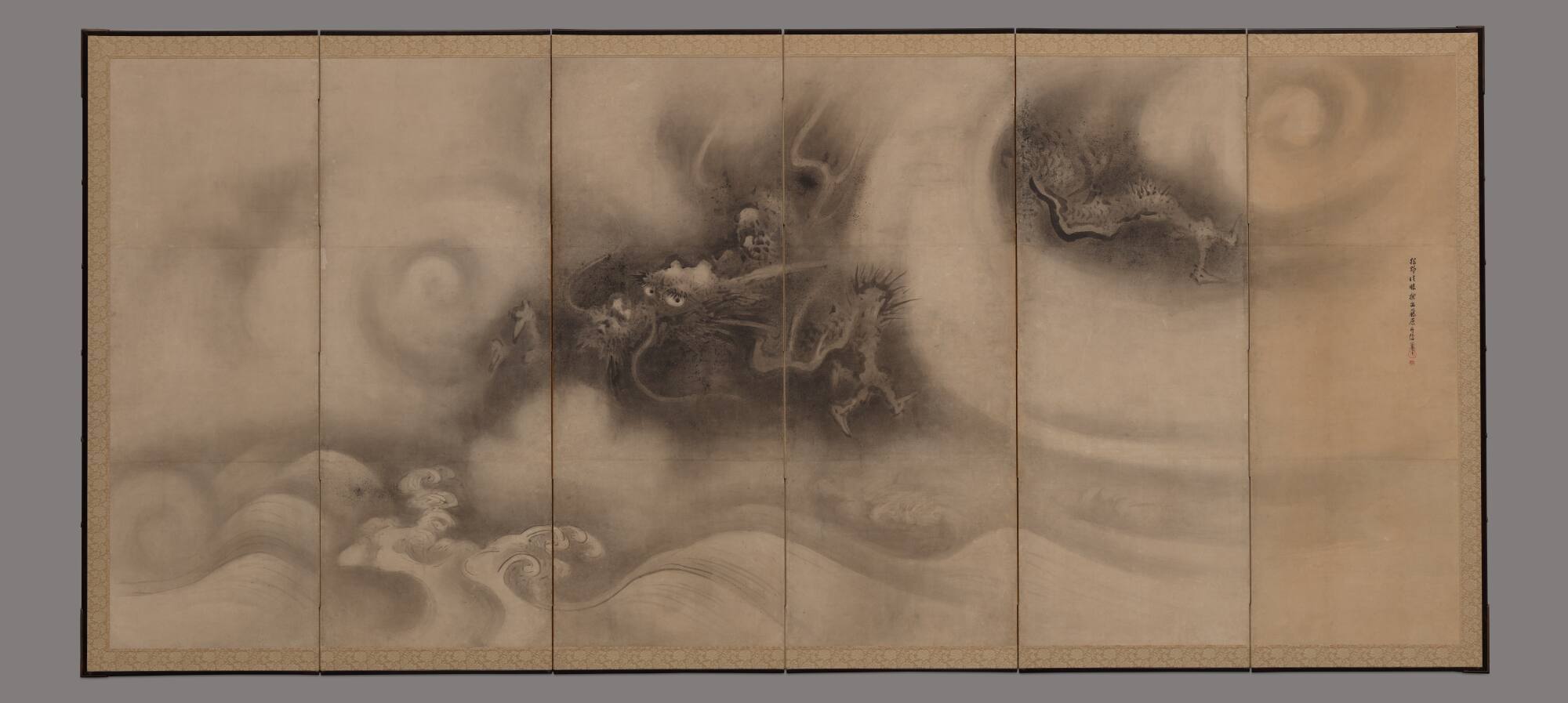
Dragon and Tiger
Original Language Title龍虎図屏風
Artist
Kano Tan'yū
(Japanese, 1602 - 1674)
DateEdo period (1615-1868)
MediumSix-fold screen; ink on paper
DimensionsOverall: 61 × 141 inches (154.94 × 358.14 cm)
Credit LinePurchase: William Rockhill Nelson Trust
Object number58-48/1
On View
On viewGallery Location
- 205
Collections
DescriptionOne of a pair of six-fold screensGallery LabelIn these dynamic paintings, Kano Tan’yū captures a dramatic moment: the dragon ascends, drawing swirling clouds around its body and churning the waters below. In East Asian traditions, dragons are revered as powerful water deities. Legends say they dwell in rivers and oceans, rising to the sky to command clouds and summon rain.
While dragons govern water, tigers are believed to control the wind, making them central figures in East Asian cosmological beliefs. During droughts, Japanese Buddhist monks performed rituals to call for rain, and in storms, they prayed for the dragon’s mercy to calm the wind and waves.
While dragons govern water, tigers are believed to control the wind, making them central figures in East Asian cosmological beliefs. During droughts, Japanese Buddhist monks performed rituals to call for rain, and in storms, they prayed for the dragon’s mercy to calm the wind and waves.
With Mr. Ōkōchi Masatoshi, Tokyo, before August, 1952.
With Mayuyama & Co., Tokyo, Japan ,by 1958;
Purchased from Mayuyama & Co. by The Nelson-Atkins Museum of Art, Kansas City, MO, 1958.Roger Ward and Patricia J. Fidler, eds., The Nelson-Atkins Museum of Art: A Handbook of the Collection (New York: Hudson Hills Press, in association with The Nelson-Atkins Museum of Art, 1993), 365.
Deborah Emont Scott, ed., The Nelson-Atkins Museum of Art: A Handbook of the Collection, 7th ed. (Kansas City, MO: The Nelson-Atkins Museum of Art, 2008), no.41, 392.
Danielle &Vadime Elisseeff, Art of Japan (New York: H.N. Abrams, 1985), pl. 423 &426.
Information about a particular artwork or image, including provenance information,
is based upon historic information and may not be currently accurate or complete.
Research on artwork and images is an ongoing process, and the information about a
particular artwork or image may not reflect the most current information available to the Museum.
If you notice a mistake or have additional information about a particular artwork or image,
please e-mail provenance@nelson-atkins.org.




See also/See also