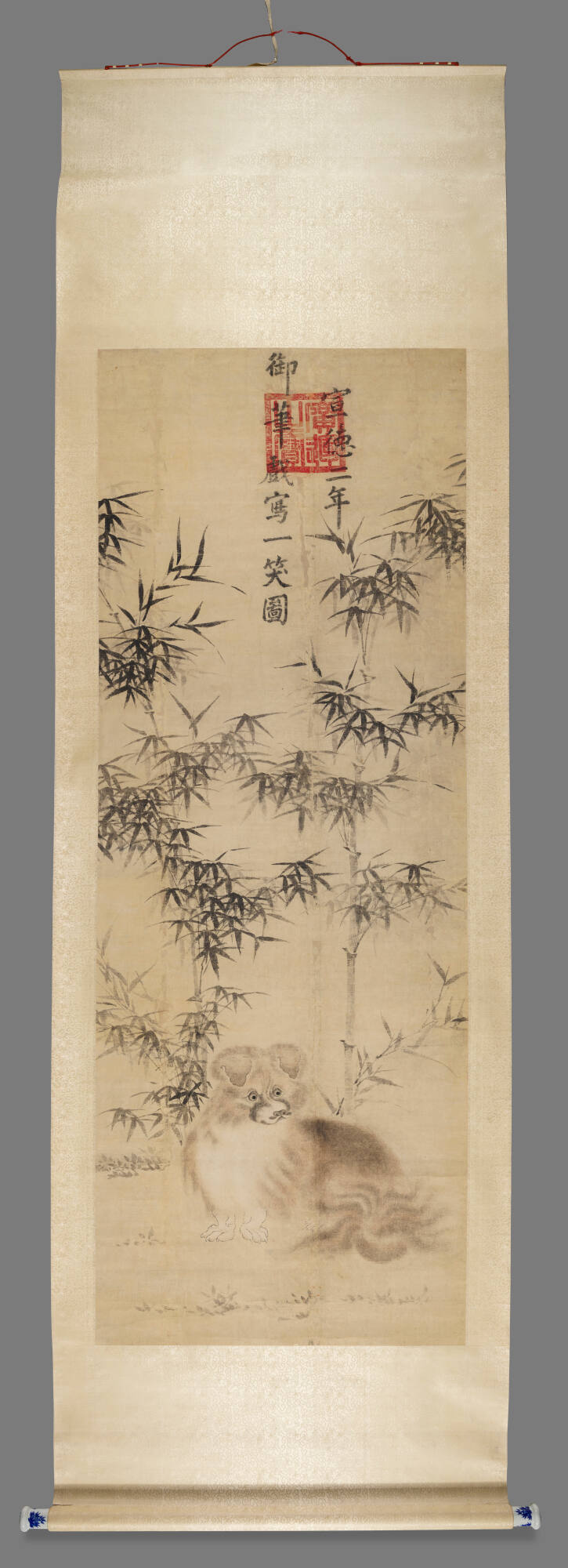
Dog and Bamboo
Chinese Great Painters of the Ming and Ch'ing Dynasties, Wildenstein & Co., New York, February-May 1949. (Organized by the Asia Institute)
Great Chinese Painters of the Ming and Ch'ing Dynasties, Istituto Italiano per il Medio ed Estremo Oriente, Rome, Italy, April-June 1950.
Ming exhibition, Detroit Institute of Arts, April-June 1952. Allen Memorial Art Museum, Oberlin (OH) College. March-April 1954.
Art in Asia and the West, San Francisco Museum of Art, October-December 1957.
A World of Flowers, Philadelphia Museum of Art, May 2-June 9, 1963. Dallas Museum of Art
Eight Dynasties of Chinese Painting, Nelson-Gallery-Atkins Museum, Kansas City, November 7, 1980 – January 4, 1981; The Cleveland Museum of Art, February 7 – April 5, 1981; The Asia Society, December 3, 1981 – February 28, 1982; Tokyo National Museum, October 4 – November 17, 1982, no. 120.
Painters of the Great Ming: The Imperial Court and Zhe School, The Metropolitan Museum of Art, March 10-May 9, 1993; Dallas Museum of Art, June 3-August 1, 1993.
Ming Paintings through the Eyes of Connoisseurs, Spencer Museum of Art, Lawrence, Kansas, January 20, 2001- March 4, 2001.
Secret Messages: Symbol and Meaning in Chinese Art, The Nelson-Atkins Museum of Art, Kansas City, Missouri, June 22, 2013- January 12, 2014.
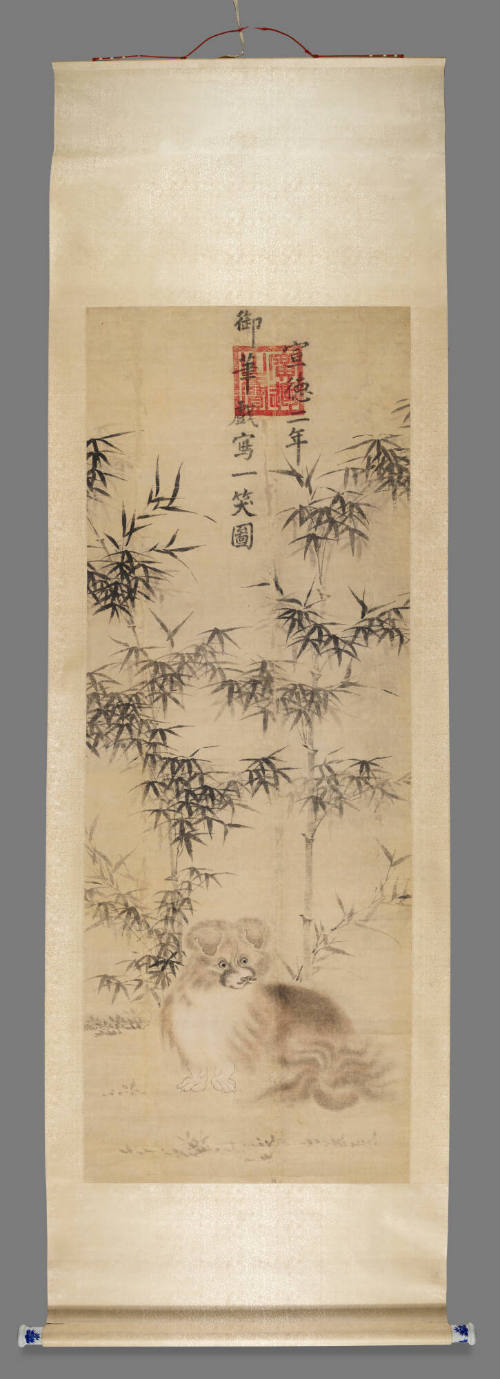
While ruling a vast empire, Zhu Zhanji developed a specialty in painting animals, particularly dogs. This arrangement of a Pekinese beneath two bamboo stalks illustrates the Chinese character xiao 笑, which consists of two bamboos 竹above a dog 犬. Xiao 笑means smile or joke, and this witty painting hints at the use of humor to defuse political tensions in the court.
With Jean-Pierre Dubosc, Peking (now Beijing), China, by 1941-1945 [1];
Purchased from Dubosc by The Nelson-Atkins Museum of Art, Kansas City, MO, 1945.
NOTES:
[1] This scroll arrived at the Nelson-Atkins on approval in 1941. The museum attempted to make payment to Dubosc through his father-in-law, dealer C. T. Loo in Paris, but World War II-related banking restrictions on foreign accounts prevented the completion of the transaction. The scroll remained at the Nelson-Atkins for safekeeping through the duration of the war. In December 1945, payment for the scroll was included as part of a larger purchase of several Chinese paintings acquired from Dubosc following a visit to Peking by Curator of Asian Art Laurence Sickman, who was serving with the U.S. Army’s Monuments, Fine Arts and Archives section in Asia after World War II. As part of his duties, Sickman made numerous trips within Japan, China, and Korea, during which he sometimes purchased objects for the Nelson-Atkins.
See letter from Leon M. Bailey, Wilson, Bundschu & Bailey, to University Trustees, September 2, 1941, copy in Nelson-Atkins curatorial files. See also C. T. Loo/Frank Caro archive, Musée Guimet, Paris, stock no. JD39/28, copy of stock card in Nelson-Atkins curatorial files.
Jean-Pierre Dubosc, Great Chinese Painters of the Ming and Ch’ing Dynasties. Exh. Cat.: Wildenstein Galleries (New York: March 11 – April 2, 1949), no. 2., p. 11,22. Foreword by L. Sickman.
Jean-Pierre Dubosc and Alberto Giuganino, Mostra di Pitture Cinesi dell Dinastie Ming e Chi’ng. Exh. cat.: Palazzo Brancaccio (Rome: 1950), no. 1, 45, pl.1.
Jean-Pierre Dubosc, “A New Approach to Chinese Painting,” Oriental Art, III, no. 2. (1950-1951), 50-57.
Osvald Sirén, Chinese Painting: Leading Masters and Principles (New York: The Ronald Press Co., 1956-1958) IV: 113; VI: pl. 124.
Grace Morley, Art in Asia and the West. Exh. cat.: San Francisco Museum of Art (1957), 3, no. 18o.
Lin Yutang, Imperial Peking (London, 1961), pl. 79.
Henry Clifford, A World of Flowers, Exh. cat.: Philadelphia Museum of Art Bulletin, LVIII, no. 277 (Spring, 1963), 183.
Wai-Kam Ho, et al., Eight Dynasties of Chinese Painting: The Collections of the Nelson Gallery-Atkins Museum, Kansas City, and The Cleveland Museum of Art. (The Cleveland Museum of Art in cooperation with Indiana University Press, c1980), 145, no. 120.
Lin Li’na, “Emperor Hsua-tsung of the Ming Dynasty, The Man, His Time and His Art” National Palace Museum Quarterly, vol. 10, no. 2 (Jan. 1993), 49, pl. 23.
Richard M. Barnhart, Painters of the Great Ming: Imperial Court and the Zhe School (Dallas Museum of Art, 1993), 55, Cat. 16.
Roger Ward and Patricia J. Fidler, eds., The Nelson-Atkins Museum of Art: A Handbook of the Collection (New York: Hudson Hills Press, in association with Nelson-Atkins Museum of Art, 1993), 323.
Deborah Emont Scott, ed., The Nelson-Atkins Museum of Art: A Handbook of the Collection, 7th ed. (Kansas City, MO: Nelson-Atkins Museum of Art, 2008), 357, fig. 227.