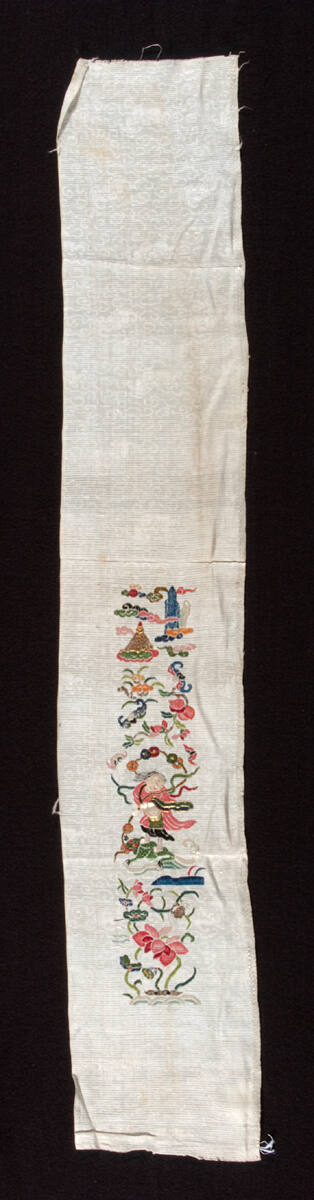


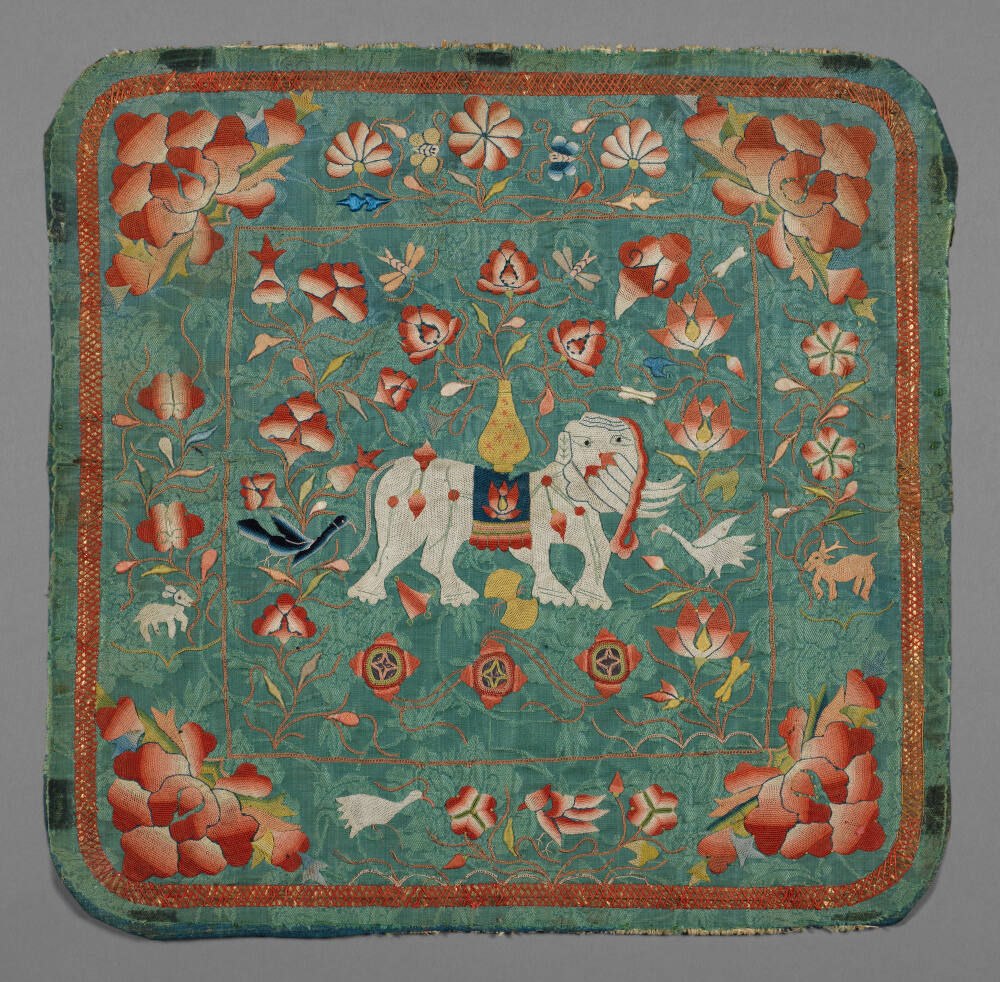
Pillow End Decorated with an Elephant and Many Animals
The white elephant is a sacred being in Buddhist scriptures. This elephant with multiple tusks wears a saddle, indicating that it is the vehicle of Bodhisattva Samantabhadra. The Bodhisattva protects believers and transmits the Sutras, the Buddha's words. Surrounding birds, insects, deer, and sheep evoke a harmonious Buddhist world.
This fragment, embroidered using a technique often used in textiles for Buddhist temples, may have been part of a cushion cover for a sacred space.
Julia St. Clair Krenz (1882-1971), by February 1936-April 1941 [1];
Purchased from Krenz by The Nelson-Atkins Museum of Art, Kansas City, MO, 1941.
NOTES:
[1] Julia St. Clair Krenz lived in China during several periods between 1919 and 1949. She worked at the American Legation in Peiping in various capacities, including as an accountant and clerk, and supplemented her income through the trade of Chinese objects. Krenz was best known for her collection of Chinese textiles, which was exhibited piecemeal at the Yale University Gallery of Fine Arts from 1931 to 1936. This object is one of approximately 400 textiles she placed on loan to the Nelson-Atkins in July 1936, shortly after her return from China earlier that year; it remained on loan until its purchase in 1941.