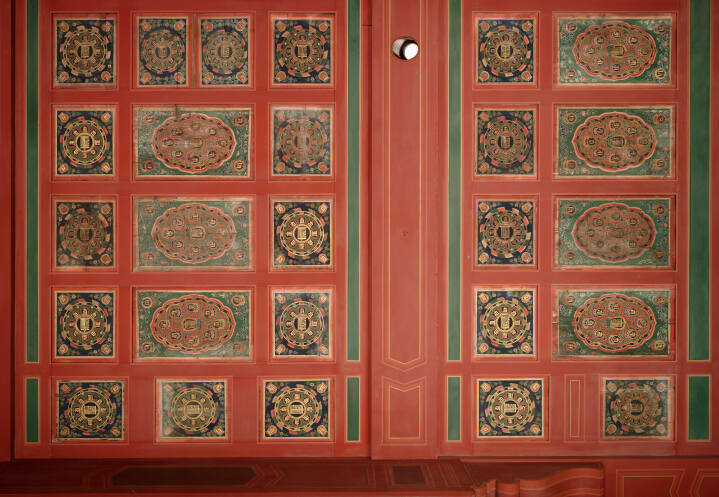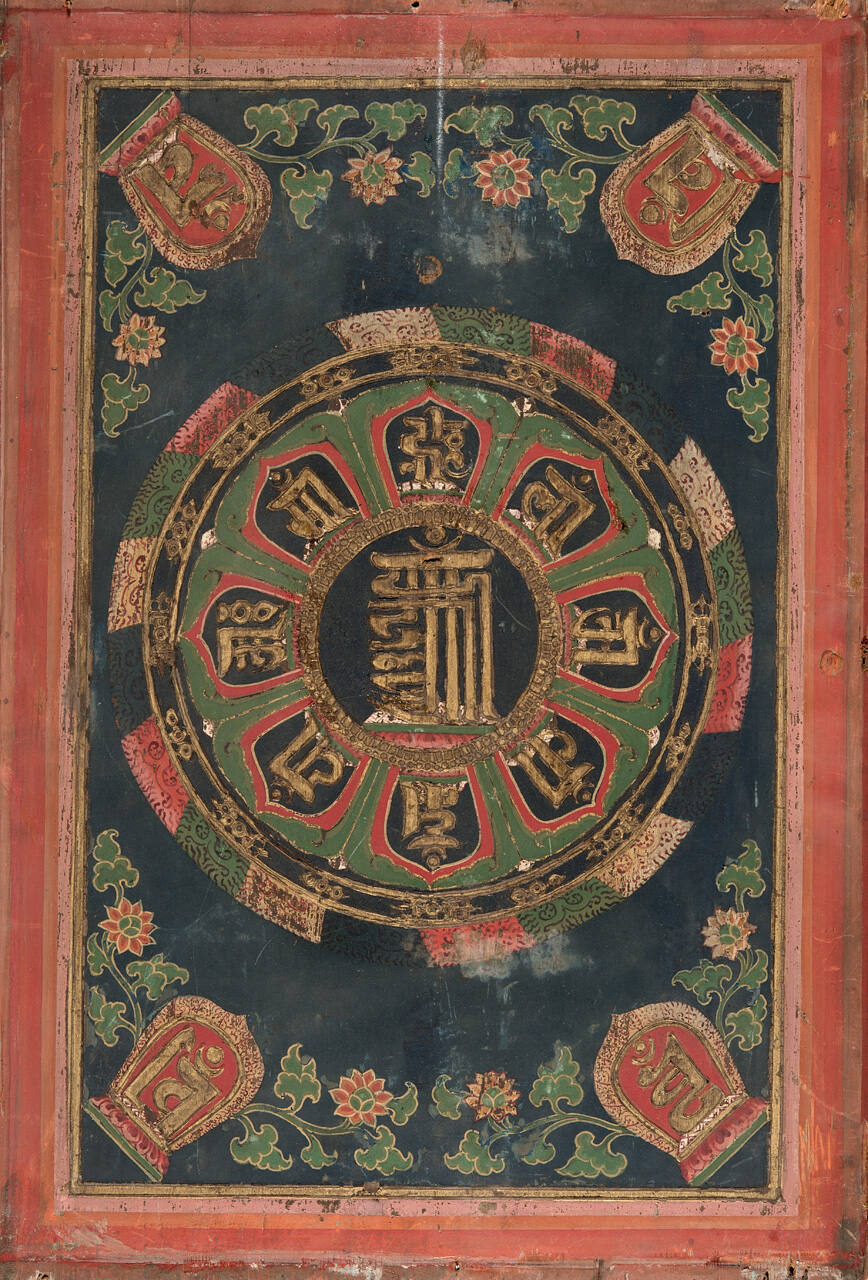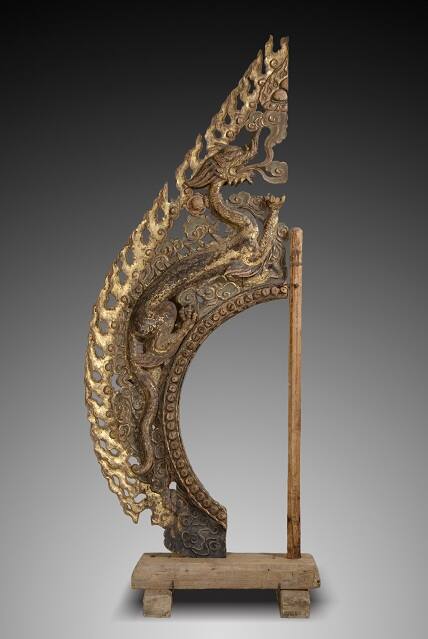


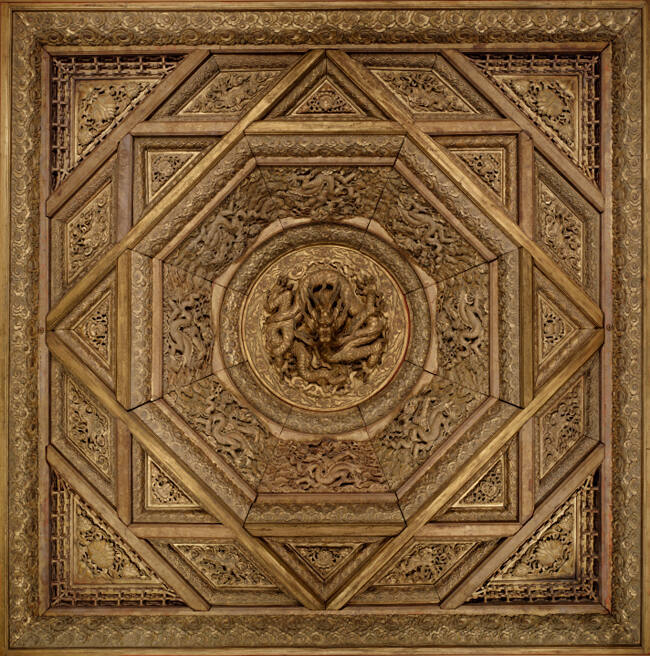
Coffered Vault with Carved Dragons, China, Beijing, Zhihua Temple
- 230
Pavilion of Ten Thousand Buddhas (Wanfoge 萬佛閣), Zhihua Temple (Zhihuasi 智化寺), Beijing, China, 1440s-1930 [1];
With E. A. Punnett & Co., Beijing, China, by May 1931 [2];
Purchased from E. A. Punnett & Co., through Langdon Warner and Laurence Sickman, by The Nelson-Atkins Museum of Art, Kansas City, MO, 1931.
NOTES:
[1] The coffered ceiling vault (zaojing 藻井) dates to the initial construction of the temple in the 1440s by Wang Zhen (d. 1449), a eunuch and tutor in the court of emperor Xuanzong (r. 1426-1435) and his son, Yingzong (r. 1436-49 and 1457-64), and was one of two such vaults located in the upper story of the building. The other vault is today in the Philadelphia Museum of Art. The additional ceiling panels (tianhua 天花) and miniature temples, acquired by the Nelson-Atkins at the same time as the coffered vault, have been argued to be later additions to the temple during the mid-to-late-18th century. For more on the history of the ceiling, see Ling-en Lu, “Buddhist Temple Reimagined: The Formation of the Chinese Temple Room in the Nelson-Atkins Museum of Art in the 1930s,” (forthcoming in Chelsea Foxwell and Wei-cheng Lin, eds., Exhibiting East Asian Art in a Global Context (Chicago: Center for the Art of East Asia at the University of Chicago).
[2] By the late 1920s, the Zhihua Temple complex was experiencing financial difficulties. In 1930, the monks removed the ceiling from the Wanfoge Pavilion and sold it to raise funds. According to Kenneth J. Hammond, “Because the ceilings were carved of nanmu, a very hard wood, they could bring a good price. One was bought by coffin makers. Laurence Sickman (1907-1988), then a student traveling in China (subsequently curator of Asian art and director of the Nelson-Atkins Museum), purchased it from them before it was cut up, paying eight hundred silver dollars.” Sickman had described the sale to “coffin makers” in a letter to Hammond dated March 6, 1987, but this information is unverified and may have been a confusion of the fact nanmu wood was purportedly favored for coffin-making during the Ming dynasty. See Hammond, “Beijing’s Zhihua Monastery: History and Restoration in China’s Capital,” in Marsha Weidner, ed., Cultural Intersections in Later Chinese Buddhism (University of Hawai’i Press, 2001): 189–208.
Nelson-Atkins acquisition documentation records that the ceiling was first brought to the Museum’s attention by Langdon Warner (1881-1955), its advisor on Asian art, who had been sent a photograph of the ceiling by the German art dealer Edgar Worch (1880-1972). Warner instructed Sickman to acquire it, and the purchase was made, with the assistance of a Chinese agent, from Beijing dealer E. A. Punnett & Co. (operated by British-born Edith Agnes Punnett, 1868-1938) in May 1931. In a letter to Fiske Kimball, Director, Pennsylvania Museum of Art dated April 22,1938, Sickman wrote: “In purchasing our temple ceiling, I worked through a young Chinese who was at that time a compradore for Miss Edith Punnett.” See Nelson-Atkins Archives, RG02 Department of Asian Art Records, series I, box 4, folder 6. It is currently unclear if Punnett acquired the ceiling directly from the Zhihua Monastery, but research is ongoing.
Liu Tun-tseng, “The Ju-lai Tien of Chih-hua Ssu, Peiping,” Bulletin of the Society for Research in Chinese Architecture, vol. III, no. 3 (Peiping, China: Society, September 1932), 1-70, pl.57 (repro.).
“Art Digest,” 8:31 (December 1, 1933), illus(repro.).
The William Rockhill Nelson Gallery of Art and Mary Atkins Museum of Fine Arts, The William Rockhill Nelson Collection, 2nd ed. (Kansas City, MO: William Rockhill Nelson Gallery of Art and Mary Atkins Museum of Fine Arts, 1941), 120, fig. 22 (repro.).
The William Rockhill Nelson Gallery of Art and Mary Atkins Museum of Fine Arts, The William Rockhill Nelson Collection, 3rd ed. (Kansas City, MO: William Rockhill Nelson Gallery of Art and Mary Atkins Museum of Fine Arts, 1949), 157 (repro.).
Jean Gordon Lee, “Chih Hua Ssu,” Philadelphia Museum of Art Bulletin, vol. 53, no.246 (Philadelphia Museum of Art, Winter 1958), 29-32 (repro.).
Xiaoneng Yang, New At The Nelson: Tang Dynasty Dragon Acquired, Nelson-Atkins, Calendar of Events (Kansas City, Missouri: The Nelson-Atkins Museum of Art, 1999) (repro.).
Jason Steuber, “Qing Dynasty Emperors Kangxi and Qianlong: Rule though Replication in Architecture and the Arts” in Original Intentions: Essays on Production, Reproduction, and Interpretation in the Arts of China, edited by Nick Pearce and Jason Steuber (Gainesville, FL: University Press of Florida, 2012), 138-211, fig. 4.16 (repro.).
Kenneth J. Hammond, “Beijing’s Zhihua Monastery: History and Restoration in China’s Capital.” In Cultural Intersections in Later Chinese Buddhism, edited by Marsha Weidner, 189–208. University of Hawai’i Press, 2001. http://www.jstor.org/stable/j.ctt6wqjjf.13.
Center for the Art of East Asia, The University of
Chicago. Zhihua Temple: Digital Restoration. Zhihua Temple Digital
Restoration | University of Chicago