
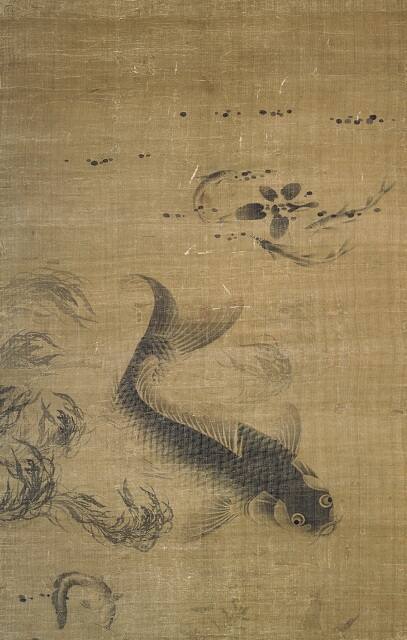
Carp and Water Grasses
Oriental art exhibition, Washington University, St. Louis, January 23-March 4, 1966.
Chinese Art Under the Mongols, Yale University Art Gallery, 1968-1969. Traveled to Albright-Knox Gallery, Buffalo, New York; Cleveland Museum of Art, October 1-November 24, 1968; Asia House Gallery, New York.
Eight Dynasties of Chinese Painting, Nelson-Gallery-Atkins Museum, Kansas City, November 7, 1980 – January 4, 1981; The Cleveland Museum of Art, February 7 – April 5, 1981; The Asia Society, December 3, 1981 – February 28, 1982; Tokyo National Museum, October 4 – November 17, 1982, no. 75.
Decoded Messages: The Symbolic Language of Chinese Animal Painting, Cincinnati Art Museum, October 9, 2009- January 3, 2010, no. 78 .
Senses and Sensibilities in Chinese Painting, The Nelson-Atkins Museum of Art, December 14, 2008- February 15, 2009.
In this painting, a carp glides through verdant waters, echoing the Daoist philosopher Zhuangzi’s appreciation of swimming as “the happiness of fish.” Carp can also jump, so those who desired success were likened to carp trying to jump through the Dragon Gate to become dragons. This carp, both a symbol of both contentment and ambition, derives its multifaceted cultural meaning from the natural movements and character of the fish.
Takahashi collection [1];
Masanari Okazaki, Tokyo [2];
With Michelangelo Piacentini (d. 2005), Tokyo, by February 1946 [3];
Purchased from Piacentini by The Nelson-Atkins Museum of Art, Kansas City, MO, 1946 [4].
NOTES:
[1] The ‘Takahashi collection’ is listed as a former collection on a card in the Nelson-Atkins files. The identity of this collector is currently unknown.
[2] Separate documents in the Nelson-Atkins files list ‘Masanari Okazaki’ and ‘T. Okazaki’ as former collectors of this scroll. Research on its provenance is currently ongoing.
[3] Piacentini was an Italian art historian based in Tokyo after the Second World War. He studied Italian Renaissance art, while collecting and dealing in Asian objects.
[4] Acquisition documents in the Nelson-Atkins files record that Curator of Asian Art Laurence Sickman purchased this object when he was stationed in Tokyo while serving with the U.S. Army’s Civil, Information & Education section in Asia (commonly known as the Monuments Men and Women) after World War II. See "Objects Acquired for the Museum by Laurence Sickman," Nelson-Atkins Archives, RG80-15 William Rockhill Nelson Trust Records, series 9, box 11, folder Laurence Sickman.
Nihon genzai shina (1938), 53.
Ho Lee, Chinese Art Under the Mongols: Yuan Dynasty (Cleveland Museum, Oct. 1- Nov. 24, 1968), catalog no. 213.
Terukazu Akiyama, Chugoku bijutsu, vol. II, (1972-1973), 245-246, pl. 70.
Chinese Art in Western Collections, vol. 2: painting, (Tokyo: Kodansha, 1973), pl. 70.
Teisuke Toda, Mokkei, Gyokkan (Tokyo: Kodansha, 1973), 133, pl. 93.
Kin-tai no boku-e, vol. 3 (Kodansha, 1975), 133, pl. 93.
Wai-Kam Ho, et al., Eight Dynasties of Chinese Painting: The Collections of the Nelson Gallery-Atkins Museum, Kansas City, and The Cleveland Museum of Art. (The Cleveland Museum of Art in cooperation with Indiana University Press, c1980), 94-95, no. 75. (repro.)
Roger Ward and Patricia J. Fidler, eds., The Nelson-Atkins Museum of Art: A Handbook of the Collection (New York: Hudson Hills Press, in association with Nelson-Atkins Museum of Art, 1993), 319.
Deborah Emont Scott, ed., The Nelson-Atkins Museum of Art: A Handbook of the Collection, 7th ed. (Kansas City, MO: Nelson-Atkins Museum of Art, 2008), 343, fig. 187.
Hou-mei Sung, Decoded Messages: The Symbolic Language of Chinese Animal Painting (New Haven, Connecticut: Yale University Press, 2009),225-227, No. 78.